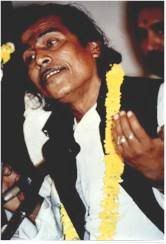
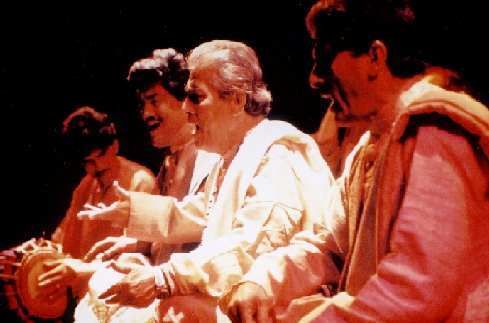
Bidur Mallik is a descendent of Radhakrishna and Kartaram, the two brothers who started the musical tradition of this family of Mithila. They appeared at the court of Darbhanga (in north eastern India, near the Nepalese border), around 1790 and made a name for themselves by averting a drought through the singing of the magical 'Rain Raga' or Raga Megh. As a result, the Maharaja of Darbhanga granted them the title 'Mallik' (Landowner), and conferred to them two villages and the surrounding landed property, where the family lives up to the present day. They served at the court up to the closing down of the state in 1947. After the death of Ram Chatur Mallik, the last actual court singer, in 1991, today Bidur Mallik is the senior musician in the family.
Born on August 15th 1936, he became the senior doyen of the Dhrupad tradtion of Darbhanga after the death of Ram Chatur Mallik in 1990. He inherited the musical knowledge and perfomance techniques of the Mallik Family, without which the annals of classical Indian music would not be complete. Together with his sons and the pakhavaj player Ramji Upadhyaya he visited Europe for the first time in 1983 during a Dhrupad festival organized by Peter Pannke in cooperation with the International Institute for Comparative Music Studies and Documentation.
Presently, he directs the 'Pandit Sukhdeo Mallik Sangeet Samiti', a music school he established in the name of his father and Guru in Vrindaban, the centre of Krishna worship and home town of Dhrupad near Delhi. His foremost disciples are his three sons Ramkumar, Anandkumar and Premkumar, who in turn are teaching their own children. As the children have already started to perform to much acclaim, three generations of the family are presently active.
The Malliks are famous all over India for a very rhythmically elaborated interpretation of Dhrupad - a style which is virtually unknown in the West. Except for old Dhrupad and Dhamar compositions - of which they possess an unparalleled stock - they are also known for their exposition of Khyal, Taranas, Ghazals, Bhajans and songs of the medieval poet Vidyapati in Thumri style.
In Europe, they appeared first in 1983, at a European Dhrupad Festival organized for the Berlin 'International Institute for Traditional Music' by world music specialist Peter Pannke, who has lived with the Mallik family in India for many years. In 1992, he invited them again for the Parampara Festival in Berlin, where they were performing together in the Tutti Shruti Orchestra. The 1993 European tour climaxed in the opening concert of the New Jazz Festival Moers, in 1994 they appeared at the legendary BBC Proms in the Royal Albert Hall in London.
I am fortunate enough to have collected a large number of hindustani classical music songs over a period of couple of years. I have uploaded some in my eSnips folder :
I am no expert of classical music nor do I understand the intricacies and technicalities of such music but still I am fascinated by it. My eSnips folder is a tribute to all those young artists who have chosen to sing this genre of music inspite of better financial and glamourous lure of playback singing in the film world. Only an absolute dedication and love for their art has prevented them from swaying to the 'other' side.
I have included about 150 artists, some of them are very young and relatively less known but in no way less talented. I am also very happy to tell you all, that this eSnips folder has attained Google Page Ranking of 3 within two months. This blog too has a 2 ranking and my other blog Indian Raga at Wordpress has a Google Ranking of 4. Both these were created about the same time as my eSnips folder. This just proves that hindustani classical music is becoming more popular than ever before.
Hindustani Classical Music artists included in my eSnips folders are :
Adnan Sami (Piano)
Ajay Pohankar
Ajoy Chakrabarty
Ali Akbar Khan
Amelia Cuni
Amjad Ali Khan
Anita Sen
Anoushka Shankar
Anup Jalota
Anuradha Kuber
Arati Ankalikar
Ashiq Ali Khan
Ashwini Bhide
Bade Ghulam Ali Khan
Badar-uz-Zaman
Barkat Ali Khan
Begum Akhtar
Bhimsen Joshi
Bismillah Khan
C R Vyas
Chandrakantha
Channulal Mishra
Chitra Singh
D V Paluskar
Devki Pandit
Dilraj Kaur
Dilshad Khan
Dinkar Kaikini
Farida Khanum
Fateh Ali Khan (Patiala Gharana)
Firoz Dastur
Ganpati Bhat
Gauhar Jan
Ghulam Ali
Ghulam Hassan Shagan
Ghulam Mustafa Khan
Girija Devi
Hariprasad Chaurasia
Iqbal Bano
ITC-SRA Scholars
Jagdish Prasad
Jagjit Singh
Jai Uttal
Jayanti Sahasrabuddhe
Jitendra Abhisheki
Kabir Altaf
Kalapini Komkali
Kalpana Zokarkar
Kaushiki Chakrabarty
Khansahib Nasiruddin Saami
Kishori Amonkar
Kumar Gandharva
L Shankar (Violin)
Lakshmi Shankar
Latafat Hussain Khan
M S Subbulakshmi
Malini Rajurkar
Malavika Kanan
Mallikarjun Mansur
Mehdi Hassan
Mitali Banerjee Bhawmik
Mohammad Bakhsh
Moinuddin & Aminuddin Dagar
Moumita Mitra
Mubarak Ali Khan
Munawar Ali Khan
Nazakat & Salamat Ali Khan
Nirmalya Dey
Pandit Jasraj
Parween Sultana
Prabha Atre
Rajan & Sajan Mishra
Rashid Khan
Ratna Basu
Ravi Shankar
Rita Ganguly
Saleem Khan
Sanjeev Abhyankar
Satyasheel Deshpande
Sawani Shende
Shivkumar Sharma
Shobha Gurtu
Shruti Sadolikar
Shubha Mudgal
Shujaat Khan
Sipra Bose
Subha Joshi
Subhra Guha
Sultan Khan (Sarangi)
Taufiq Qureshi
Trilok Gurtu
Uday Bhawalkar
Ulhas Kashalkar
Vaishali K S
Vasundhara Komkali
Veena Sahasrabuddhe
Vishwa Mohan Bhatt
Zahida Parveen
Zakir Hussain
Zarina Begum
Zila Khan
... and many more.
More artists will be added soon. While visiting my classical music folder at eSnips don't forget to have a peek into my other music folders which have some interesting music of different genres. All the music is raga based.
Melody is the fountainhead of Indian music and ragas are the fundamental organizing principle of Indian classical melody.
Ragas are fixed sequences of a minimum of five notes arranged in ascending and descending order (respectively the aroha and avaroha). Unlike contemporary Western scales, but like the modes of early European music, the ascending and descending notes are not identical. Adjust the sequence or introduce an extraneous note and the result will be a different raga. Since ragas have been systematically studied for centuries their permutations have been calculated mathematically and defined scientifically. New ragas do come into being, however, through the blending of elements of two ragas to produce a so-called mishra or mixed raga with the names of the parent ragas. At times, too, apparently new ragas have turned out to be unknowing rediscoveries of ragas that have dropped out of the repertory. A double-barrelled name tends to indicate a mishra rage, but not always: "Todi" in a raga's name — examples being "Shuddha Todi" and "Gurjari Todi" — is an adjectival construction denoting that it originated in a particular location. Hindustani musicians, to generalize, use a more limited palette of ragas than their Carnatic cousins.
Ragas unfold in a set order. The opening movement, called alap in Hindustani music, is a leisurely, precise, impassioned unfolding of the raga's essence. It teases out the mood with melody, seeking and setting out that mood without any rhythmic accompaniment or rhythmic pulse. One of its foremost exponents is the sarodist Ali Akbar Khan. His recording, Ali Akbar Khan Plays Alap, is a perfect introduction to this art. "Alap," he wrote in that album's sleeve notes, "has fifteen parts. Training in alap is not for beginners or even advanced students, just as you don't offer a drink or reveal all your property to a small child." The second movement is called the jor. In an instrumental context this part will take on a rhythmic form but still without the assistance of percussion such as tabla or pakhawaj. The next major development is the jhala which has percussion accompaniment. This is the final fast movement. There are a number of intermediate steps in the process and etiquette varies about their inclusion or exclusion.
Carnatic music has its equivalent terms. Alapana is its equivalent of alap. The classic sequence and most elaborate item in a Carnatic concert is known as ragam-thanam-pallavi (the hyphens are optional). Opening with the melodic, unmetered ragam improvisation in the particular raga, it moves into the thanam and concludes in rhythmically metered improvisations on the pallavi (song text).
Ragas have been scientifically dissected for generation upon generation. They have even been placed in families. Ragas are attended by consorts or wives called raginis, ragaputras and ragaputris, respectively their sons and daughters. They have been analyzed to identify which `environment' they belong to — whether they belong to a particular season or hour. "Raga Megh" or "Megh Malhar" is associated with the monsoon season, megh means cloud. "Vasanta" — literally, spring — is a raga for springtime (and by extension has characteristics similar to sunrise ragas). The psychological characteristics of notes give them a personality — a feminine aspect, a dark color, an uplifting sensation — and hence all the major ragas have their appropriate time of day. Great store is placed in getting this right, even to the extent of listening to recordings at the proper hour.
Rhythm and Tala :
In Indian music tala, tal or taal is the rhythmic cycle of a specific number of beats. A specific tala are expressed as compound nouns, sometimes split into two words. Throughout this text the convention is to give them as one word. Jhaptala consists of ten beats. Chautala is one consisting of 12 beats. Ektala is also 12 beats but the term is the one used for tabla rather than chautala which is associated with pakhawaj.
Classical Song Forms :
There are many, many singing styles and it is only possible to explain a little about the most frequently encountered. Classical song forms tend to be separated into classical and light classical (sometimes called semiclassical) forms. Light classical forms include ghazal, bhajan and qawwali. Classical forms include thumri and dhrupad. Folk styles are even more numerous. Many folk styles relate exclusively to particular regions, religions or musician castes.
Bhajans :
Bhajans are the most popular form of Hindu devotional composition. They are found especially in the repertoires of Northern Indian musicians. In the South the commonest Hindu vocal style is the kriti. However, Carnatic musicians — the violinist V.V. Subrahmanyam, for example — also include bhajans in their repertoires. Thus instrumentalists will also include them in their repertoire and therefore part of the art is to capture the sonorities, mood and meaning of the words in their playing or to bring these elements out if accompanying a vocalist. The increased exposure of Hindustani music in the South has led to Northern Indian bhajans by composers such as Mira, Kabir and Tulsidas being performed. These tend to be set to the appropriate Hindustani raga but sung to Carnatic talas which are often rhythmically more sophisticated.
Dadra :
Dadra is a light classical song form similar to a thumri sung in a tala of six beats.
Dhrupad :
Dhrupad is an ancient form of the classical singing. One of the most commonly encountered forms, it places great emphasis on the lyrical content, rhythmic accuracy and clear enunciation. Lyrically dhrupad is set in a medieval form of Hindi called Brijbhasha or Braja Bhasha but it is also sung in modern-day Hindi, Punjabi, Bengali and Rajasthani. Many commentators decry the sacrificing of dhrupad's high literary and poetic standards by today's more popular forms. Usually set nowadays in a uniform tala or rhythmic cycle of 12 beats (chautala), historic accounts report a far greater rhythmic sophistication with each line being set in a differing tala from the preceding one. This would involve singing one line in chautala and the next in jhapatala of ten beats. Dhrupad compositions may eulogize gods or royalty. They are especially known for mining religious and heroic seams but there are worthy traditions of subject matter as varied as philosophy, metaphysics and eroticism as themes. A dhrupad is composed of four elements. These are melody (raga), tempo (laya), rhythm (tala) and its melodic components (dhatus).
Dhamar :
Dhamar is a related form which employs more gamaks or grace notes than dhrupad, usually set in a tala of 14 beats. To no little extent both forms have been displaced by the principal contemporary classical form, khyal, in particular but also by thumri and tappa. Among dhrupad's most noted singers are Candanji Caube (1869-1944), Siyaram Tiwari, Ritwik Sanyal, Ram Chatur Mallick and various combinations known as the Dagar Brothers.
Dhun :
A dhun is a melody lighter in tone than a raga and often derived from a folk tradition. In such cases it will be labeled with the region of origin such as "A Rajasthani Dhun." Being free from the strict discipline of the raga system, it allows liberties with the notes which the musician may include.
Ghazal :
Although an Indo-Muslim light classical form, ghazal enjoys widespread popularity. A development of one of the main poetic and literary traditions of Persia, its name derives from the Arabic for `talking to women'. It is therefore often viewed as a conversation or a dialogue between a lover and his beloved. This can be sacred, profane or allegorical. It is closely associated with the major Indo-Muslim language, Urdu. At its heart is love of either the romantic or devotional kind. Since the mid-‘30s secular and political themes have increasingly crept in, most famously through the work of the poet Faiz Ahmad Faiz (1911-1984). Ghazals have formed the core repertoire of a number of performers ranging from Jagjit & Chitra Singh to Begum Akhtar and Najma Akhtar.
Khyal :
Sometimes rendered as khyel or khayal, is generally translated as imagination or fancy — indications of its lightness and reliance on the performer's powers of improvisation. It is also translated as whim or idea but the etymology of khyal is, as one commentator put it, abstruse, and no records of any authority exist about the beginnings of khyal. By the 18th century A.D. the form had taken shape in the court of the Mughal emperor Mohammed Shah in Delhi. Since then khyal has loosened the hold that dhrupad traditionally had to become the staple style of Hindustani classical music. Paradoxically, some musicological soothsayers have warned that popular taste looks set on loosening khyal's hold in favor of thumri, dadra, chaiti and kajri (a folk song form originally from Uttar Pradesh).
Kriti :
The Carnatic kriti (or krithi) is a song of praise or adoration for a particular Hindu deity. Kritis are especially associated with Tyagaraja (or Thyagaraja) (1767-1847), Muttuswamy Dikshitar (1776-1835) and Syama (or Shyama) Sastri (1762-1827), a famed trinity of musician-saints or saint-composers. In order, appreciating the trinity's work has been likened to the grape, the coconut and the banana. The first can be consumed and enjoyed immediately. The second involves cracking open a shell to get to the kernel. The third involves the removal of a soft outer layer to get to the fruit. Their era is known as the Golden Period of Carnatic Music and during their time they composed a collection of timeless compositions. Tyagaraja alone is credited with some 600 kriti compositions. Kritis are usually composed in Telugu, Tamil or Sanskrit are habitually seeded in specific ragas.
Qawwali :
An Indo-Muslim devotional music of light classical complexion sung in Urdu, Persian, Punjabi and other northern Indian languages.
Tappa :
Tappa is a song genre popularly and romantically supposed to have arisen from the songs sung by the camel drivers of the arid northwestern regions of the subcontinent. The language it is most frequently sung in is Punjabi. It is typified by passages in fast tempos.
Tarana :
A song genre in which meaningless rhythmic syllables substitute for a lyric similar to syllables replacing words in, say, Ella Fitzgerald's scat singing or jazz vocalizing. While the concept is easy to grasp, maintaining artistic integrity and musical interest over the length of a tarana is not. A tarana section will frequently conclude a khyal performance and will be substituted for the fast tempo or drut khyal. Unlike its Southern counterpart known as the tillana, taranas are opportunities to extemporize.
Sawani Shende is a very popular up-and-coming vocalist of her generation. She is a student of Smt. Veena Sahastrabuddhe, a well known classical vocalist of international repute. Sawani has performed in prestigious music conferences all over India and also toured U.S.A/Canada in 1998. She has received prestigious awards like Pt. Jasraj Gaurav Puraskar, Smt. Manik Varma Puraskar and Pt. Ramkrishnabua Vaze Puraskar. Sawani has several cassettes and CDs to her credit.
Sawani was born in a musically rich family. She was introduced to Indian Classical Music at a tender age of six by her grandmother, Smt. Kusum Shende, herself a noted singer of Kirana Gharana. Quest for more and more knowledge in music at the age of 12 Sawani started her training under the expert guidance of Dr.Smt Veena Sahasrabudhe, a noted classical vocalist of Gwalior Gharana. Sawani’s father, Dr.Sanjeev Shende has groomed her in semi classical generes like Thumri, Dadra, Kajri, etc.
Sawani made her debut at the age of 10 to celebrate her grandmother’s 61s birthday. The journey of concerts started when Sawani was invited to perform at the prestigious Pt. Vishnu Digamber Jayanti Samaroh in Delhi when she was just 12. Sawani was honored when she performed for the then President of India, Mr. R. Venkatraman at the Rashtrapati Bhavan. Since then she has never looked back.
Sawani’s music is a beautifull soul searching combination of Kirana Gharana and Gwalior Gharana, where she mesmerizes audiences with enchanting melody & strength of both.
Sawani’s confidence and mastery in Khayals, her crystal clear diction and overall sensitivity in presentation takes every performance to a very high aesthetic level. Her rendition of semi classical genres highlights the emotive and expressive quality of Indian Classical music and adds a very important dimension to her performance leaving audiences spellbound.
Sawani gave concerts in prestigious music festival all over India. She has also performed in 30 states all over USA and Canada. She also gave performances in Doha, Dukhan and Umsaid.
Listen to one of her mesmerizing rendition in Raga Durga ‘Bajavat Veena‘ which is one of my favourites :
Rashid Khan, born in 1966, is perhaps the most convincing proof of what miracles the revived Gurukul system can achieve. Under the tutelage of Ustad Nissar Hussain Khan, the Sahaswan Gharana maestro, for the last ten years in Research Academy, Calcutta, Rashid has metamorphosed from a gawky, groaning child to an artiste of unbelievable maturity, vocal prowess and artistry.
Rashid's alap is ticklishly imaginitive, his rhythmic play pulsating and the cascades of his powerful, lightening, swift taans unimaginable until actually heard.
Rashid has naturally taken listeners and the Press by storm wherever he has gone, and at a conference at Bhubaneahwar in 1982, a member of audience was so overwhelmed by the uncanny expertise of the young boy that he promptly made him a gift of one thousand Rupees.
In 1986 the Festival of India authorities invited Rashid Khan to present the only music recital on the occasion of the release of Double Album on Great Masters of Music by the then Prime Minister of India, late Rajiv Gandhi. The concert was intended to signify the continuance of the tradition of excellence in Indian classical music.
Rashid Khan was awarded the 'A' Grade by All India Radio in 1987. In 1988 he cut his first record. Doordarshan has produced and telecast a special programme on this phenomenon. In 1989 Rashid Khan made an extensive tour of the United States and Canada, taking, as usual, crowds by storm.
Rashid Khan has been hailed as a great successor to the Bade Ghulam Ali Khan - Ameer Khan generation - an era today almost given up as lost. He had truly arrived on the scene when Pt. Bhimsen Joshi heard him at a concert in early 1988 and proclaimed that there is now at least one person in sight who is an assurance for the future of Hindustani Vocal Music.
Listen to this composition sung by him in Raga Jaijaivanti from his album 'Mercy Rain' :
Pandit Bhimsen Joshi, was born in Gadag (Karnataka) on 14 Feb 1922. Pt. Bhimsen Joshi left his home for Gwalior, then to Calcutta then Rampur where he took lessons from Mushtaq Husain Khan.
He finally became student of Savai Gandharva (Pt. Rambhan Kundgolkar), the eminent khyal singer student of Abdul Karim Khan. Pandit Bhimsen Joshi is the long-reigning king of Hindustani classical vocal music. His unpretentious style, his soulful appeal and his divine sur have made him the paragon of reverence. Loyal to Kirana tradition, yet innovative, he has contributed immensely to Indian music.
A few years of his youth were thus spent in the company of well known musicians at Gwalior, Lucknow and Rampur, serving them and learning as much as he could from them. His father, coming to know of Bhimsen's fervent desire for knowledge in music, abandoned his policy of opposition, fetched his son back and made arrangements for him to learn under the guidance of Sawai Gandharva of Kundol. This opportunity opened the vaults of rich and rare musical treasures to Bhimsen. Bhimsen's natural tuneful voice received further polish from his guru. Like a diamond which sparkles all the brighter after it is expertly cut, Bhimsen's voice began to shine with a new lustre and brilliance which has dazzled and cast a spell on the entire country.
With his increasing popularity Bhimsen started getting invitations to sing at various cities and towns in Maharashtra and Karnataka. To facilitate the keeping of these engagements, he bought a big car and took to driving. The car was so big that it could easily accommodate him and his 4 accompanists besides two tanpuras and other instruments. In this car Bhimsen travelled extensively. One day he would go from Bombay to Belgaum - then on to Bangalore the next day, and back to Pune- only to go off again to Nagpur, Raipur or Bhilai. Back again in Pune, he would rush off to Hyderabad, Solapur and so on these whirlwind tours became a habit with him and in a short while he became an expert driver.
His unbelievably flexible voice enabled him to traverse at terrific speed, the great range of 3 octaves. While at the wheel, he used the same technique as in singing. The spread of his fame and popularity beyond the boundaries of Maharashtra brought him invitations from far off places like Jullundur, Jammu, Srinagar, Delhi, Calcutta and Gauhati. Bhimsen, who had so far matched the speed and agility of his voice with the speed of his car. He then had to switch to air travel. The pilots of Indian Airlines and airport oficials came across Bhimsen so frequently that he was soon known as the 'flying musician of India'.
One can easily imagine the tremendous difficulties involved in getting hold of an ever-busy singer like Bhimsen for recording. Fortunately as his popularity increased rapidly, the recording technique also improved for the better. 78 R.P.M. records were now replaced by the 45 R.P.M., extended play records and 33 R.P.M. long-playing records. Extended play records played twice as long as the 78 R.P.M. The long-playing microgroove records were also proportionately higher priced. These records gradually became the exclusive privilege of the affluent in society. His EP included Zanak Zanakuva in Raga Darbari. Piya To Manat Nahee (see link below at the bottom of this post) , a thumri, Jo Bhaje Hari Ko Sada, a bhajan, and the most enchanting thumri - Piya Ke Milan Ki Aas
Every performer has his favourite items, in which he excels. On the strength of these- his mehfil becomes a memorable experience. Bhimsen is no exception. After hearing a number of his concerts some people remarked that his programmes are repetitive. It is a peculiar characteristic of our music that the ingenuity of a musician is known by his ability to unfold and create new and novel facets of known raas. The same composition, same notes in the same ragas, presented on successive occasions can sound ever-new, fresh and enchanting and receive enthusiastic approval from listeners and critics in the audience. It is very necessary therefore that the listeners should cultivate a knowledgeable interest and a musical ear to appreciate our classical music.
Supreme confidence in his own abilities and unfailing loyalty are two prominent qualities of Bhimsen. Every year he observes the punyatithi (death anniversary) of his guru Sawai Gandharva with a music festival at Pune. Those privileged to attend it are indeed very fortunate, for the spectacle is one fit for the gods. For three consecutive nights about 10,000 people attend the programme from 8 at night to 7 the next morning. Eminent artists in the world of Indian classical music vie with each other for a chance to appear on the stage on this occasion. There are two reasons for this. Firstly the programme is at the behest of a great fellow artist like Bhimsen, and secondly it is rare and almost impossible for a musician to get a chance to perform before such a vast, discerning and appreciative audience. During these celebrations, Bhimsen works like an ordinary volunteer. On occasion he is even noticed sweeping the stage, bringing the instruments on stage and helping the artist to tune the tanpuras perfectly. He looks after the comforts of the artists and audience alike. He does this untiringly for three successive nights. One cannot help but admire him for his love and reverence for his guru.
The late Sawai Gandharva was a disciple of Abdul Karim Khan. A galaxy of veterans are among his disciples. They include top names like Gangubai Hangal, Hirabai Badodekar, Phiroz Dastur and Bhimsen, who is the youngest of them all. The characteristics of the Kirana gharana are precision-oriented tunefulness (lagav of swaras) presentation of a bandish with an impressively grace- ful style, and a disciplined, systematic and methodical raga de- velopment, punctuated with an elegantly elaborate alap and skil- ful decoration with the choicest forms of embellishments - taans. With the help of all these, Bhimsen makes such a terrific favourable impact on his audience right from the start of the concert that listeners remain glued to their seats till the last notes of his Bhairavi. Within a few minutes of his arrival in a concert hall Bhimsen measures correctly the pulse of the audi- ence. His discerning eye unfailingly recognizes the knowledgeable in the congregation and, by the time the tanpuras are tuned, and accompaniment arranged, he has decided on the musical menu he will dish out to achieve a resounding success.
Bhimsen is a versatile singer; he is an expert in khayal singing but he is also adept in the presentation of thumris, songs from plays, or devotional compositions. His lilting thumris (Jadu Bhareli, Piya Ke Milan Ki Aas or Babul Mora) and his innumerable popular Abhangs composed by the saints of Maharashtra are instances in point.
Bhimsen is a prodigy - unique - a divine miracle. We should admire his tremendous accomplishments in the realm of music, revel in the heavenly experience of his gayaki and pray to God Almighty to bless this musical genius with a long life. In the whole of India there is no one else who has atained so much and given so much to music lovers. Listeners in he U.S.A. and the U.K. love and admire him. It is a pity that our Government has only bestowed a mere Padmashri on him, instead of the higher honours deserved by an artist of Bhimsen's calibre who has received the greatest acclaim abroad.
Listen to a Thumri in Raga Kafi performed by him, which is an all time favourite of mine :
Amongst the vocalists of the younger generation of the Jaipur-Atrauli tradition of Khyal singing, Ashwini Bhide-Deshpande is an artiste of great caliber. She has been performing in a number of prestigious music conferences in India for over fifteen years and have had successful concert tours of Europe as well as of North American continent.
Ashwini began her training at the age of five under the guidance of Pandit Narayanrao Datar. After graduating with a "sangeet visharad" from Gandharva Mahavidyalaya, she started receiving guidance and meticulous attention from her mother, Smt. Manik Bhide, a great Khyal singer herself. Ashwini has inherited all that was best in her mother's style and was able to add a lot to her repertoire with great sensitivity and intellect. Presently she is receiving guidance from Pandit Ratnakar Pai, a veteran of the Jaipur gharana.
Systematic exposition of the Raag structure, brilliant phrasing, variety of taan patterns, ease and grace in all of the three octaves mark her singing. She does not merely present the gammer of a Raag, but can build it up into an aesthetically pleasing experience.
A resident of Mumbai, Ashwini is a graduate in Microbiology and also holds a Ph.D. degree in Biochemistry.
Here is one of her rendition in Raga Bhup, Malaniya Layi :
Born in Azamgarh District, Uttar Pradesh, Channulal Mishra received his training in music under his father Pandit Badri Prasad Mishra, and then from Ustad Abdul Ghani Khan of the Kirana gharana. Channulal Mishra is a versatile and popular vocalist with a rich repertoire of Khayals, Thumris, Dadras, Kajris, Chaitis and Bhajans. He is also a scholar who has delved into the aesthetic subtleties of Indian classical music under the guidance of Thakur Jaidev Singh.
Amitabh Bachchan, the film star is known to be a big fan of Mishra ji especially of his Purab Ang Gayaki that may have inspired the actor to sing in his films in the style for which he is so well known for.
He received the Naushad Award from the Government of Uttar Pradesh in 1995.
Here is a Khayal in Maru Bihag which is one of my all time favourites :
Mitali Banerjee Bhawmik, a rising star of the Hindustani Classical vocal music, was born in Nogaon, Assam. She started her music lessons at a very early age from Sri Ajit Dutta. Later she received extensive training in classical vocal music from Pandit Sri Biren Phukan of Guahati Assam. Mitali then came to Calcutta where she received lessons from Srimati Meera Banerjee, the renowned vocalist. Since 1983, Mitali is under the tutelage of Padmabhusan Pandit V.G. Jog, the famous violin maestro.
Mitali has performed in several concerts in India and USA. In India she has performed at the Sangeet Research Academy, Bhawanipur Sangeet Samaj, Salt Lake Music Festival in Calcutta, the Calcutta School of Music, the World Bengali Conference, Spic-Macay at IIT Kharagpur and several others.
In USA some of her performances include, Ali Akbar College of Music at San Raphael and Fremont in California, concerts in Los Angeles, Santa Cruz, Dallas, Princeton University, Yale University, Rutgers University. Mitali has also been a regular performer at the Hindu Milan Mandir Annual Music Conference in NJ, Sangeet Prabhaat organized by Marathi Viswa of NJ and many others.
Mitali has been gifted with a very strong and melodious voice which is perfectly suited for the Khayal and Thumri style of Hindustani music. Her soulful rendition of the Ragas have kept the audience mesmerized and has won her many appreciations and accolades. She also performs the more lighter forms of Hindustani music like Bhajans, Ghazals and Geets with equal grace and perfection.
Mitali currently resides in Monmouth Junction in New Jersey and teaches music to the students in the area. She and her students have won the prestigious New Jersey Arts Council fellowship grant to continue learning Hindustani Classical music from her.
Mitali has recently released her debut CD album "Vandana". In this CD Mitali is blessed by her Guruji Pandit V. G. Jog's violin accompaniment. Mitali performs Khayal in Raga Anandi Kalyan, followed by a Hori Thumri, a Dadra, and a Bhajan.
Moumita Mitra, born on 22nd Dec.,1980 is a Hindustani (North Indian) Classical and Semi-Classical Vocalist. She is a disciple of Lt. Pt. A.Kannan and Sri Anjan Majumdar. She stood first in Khayal and Thumri in The DoverLane Music Competition in the years 2001 and 2004 respectively.
Moumita has received the Championship Award from The DoverLane Music Conference Organization in both the years for being the Highest scorer and Best Vocalist. She was given the honour to perform at the inauguration ceremony of DoverLane Music Conference 2002 on its Golden Jubilee celebration.
Moumita is a National (India Government’s Department of Culture) Scholarship holder from the year 2003. She has been conferred the title of “Adwitiya 2004”for becoming the winner in the Classical round of the music competition organized by Anandabazar & Shalimar, all over West Bengal. Second runner’s up in All India based competition organized by Swar Vilas, Vadodara, Gujrat in 2005. Winner of “Gaan Antaheen”, a Music competition in Doordarshan(National Television Network).
She has also performed in various prestigious Concerts in India, some of them are…. The Dover lane Music Conference, Kolkata in August,2002, Swar Vilas Baroda (Gujrat) in 2004 and 2005, The Youth Conference on Indian Classical Vocal Music in Kolkata, 200 3, The Annual Classical Music Conference by “Aanandi” at Kolkata, 200 5, Shalimar “Adwitiya” title giving ceremony at The Science city auditorium, 7th Aug., 2004. She also has a Music Album from HMV(Saregama) to her credit.
“The girl (Moumita Mitra) who sang on stage just now, if she gets the right opportunity, she will sing all over the country sooner or later. She has a flawless voice.”……..quoted by Pt. Jasraj on stage at the inaugural ceremony of 50th year of Doverlane Music Conference. 22nd Jan., 2002.
I myself highly rate this new and upcoming artist and predict, if I may do so, a very bright future for this young girl.
You can listen to one of her rendition, a Thumri in Tilak Kamod - 'Ab Ke Sawan Ghar Aaja'. I hope you will enjoy as much as I did :
Blessed by prodigious natural talent and a cool temperament, Kaushiki has not been distracted for one moment by all the accolades and acclaim she has justly received at such a young age. Her last Sense World Music recording ‘Pure’ received worldwide recognition beyond the circles of traditional classical music listeners and confirmed a level maturity and depth in her singing which defies her years.
Following on from her success at the BBC World Music Awards in 2005, this unique collection of both studio and live concert recordings demonstrates why Kaushiki has become the great hope for the future of Indian classical vocal music, giving us an invaluable insight into the full range of her musical prowess.
Kaushiki was born in 1980 in Kolkata, the cultural capital of modern day India. Her parents noticed that she could reproduce complex musical and rhythmic phrases at the age of just two years. Being an able teacher her mother Smt. Chandana Chakrabarty took care of her ‘taleem’ (music training) adopting the role as her first Guru. Subsequently, Kaushiki had the fortune to become the youngest Ganda Bandh disciple (or shishya) of the renowned Bengali educator Guru Jnan Prakash Ghosh when she was just ten. Ganda Bandh is a traditional knot tying ceremony which cements the relationship between guru and student. Later on, after intermittent ill-health, Jnan Prakash Ghosh ordered Kaushiki to continue further training under the tutelage of his most successful disciple, her father Pandit Ajoy Chakrabarty, one of the most creative and influential Indian vocalists of the modern era.
The guru-shishya system of teaching is the most intensive and effective route of musical learning in North Indian Classical music. Based on the oral tradition, it embodies the living and learning relationship between master and pupil, involving the complete emotional, intellectual and spiritual surrender of the ardent shishya (trainee) to the guru (teacher).
Here is a sample of Kaushiki’s prowess in singing :
Ustad Bade Ghulam Ali Khan can be described as an artist who has had the maximum impact on the 20th Century Hindustani Classical Music scenario. Born in 1902 into a great musical lineage from Kasur in the Western Punjab, this great savant amalgamated the best of four traditions, his own Patiala - Kasur style, sculpturesque Behram Khani elements of Dhrupad, the intricate gyrations of Jaipur and finally the robust behlavas (embellishments) of Gwalior. But what actually characterised Bade Ghulam Ali Khan was an effervescent melodic quality which was concertised in a masterly flow of ideas which were delivered with a unique sense of alacrity, aided by one of the most pliable and dextrous voices ever heard in living memory in this land.
Bade Ghulam Ali Khan had a relatively short career span. He blazed the trails of Calcutta in 1938 and in the 1944 All India Music Conference in Bombay, was virtually anointed Lord of all he surveyed in the field of Indian Music. But 24 years later, he was dead, prematurely at 66, having given the World less of himself than it would have wished to have. The maestro’s approach to khayal was essentially traditional - as seen in the medium pace of his vilambit Khayal presentation and his style of straightforward sthaibharana avoiding permutations. The character of his Gayaki was derived from an inclination towards looking beyond the traditional method of intoning a Swara to discover unchartered facets of beauteous melody, often achieved by very subtle inflexions of notes. This approach was bom of a mind which always strove to find that beauty in Indian Music which went beyond the Raga itself.
For Bade Ghulam Ali Khan, ‘Taleem’ was but a means to a greater end where sheer melody and freedom of movement became unified His music was the joyous expression of an unfettered musical psyche. In ‘Thumri’, Bade Ghulam Ali Khan looked beyond the tradition of bol-banav where verbal and musical expressions are unified. He saw in Thumri an avenue for playing with notes with even greater abandon than was possible in the raga-restrained Khayal. From this perspective was born the now well-established Punjab-ang of Thumri.
Here is a rare live recording of the maestro in Raga Pahadi :
She was the last of an era that was. Zarina Begum was once the star attraction at royal mehfils and marriages, singing thumris, dadras and ghazals. Today, she wonders where her patrons have gone? Khush hoon ki mera husn-e-talab kaam to aaya, Khaali hi sahi meri taraf jaam to aaya…The sound of her captivating voice draws you up a narrow staircase, wide enough for just one person, broken at places, to reach her abode. There is nothing in the impoverished surroundings of that one-room hovel to indicate that it has ever seen better days. But Zarina Begum, now nearly ninety, has. Among the last of Lucknow’s famous mehfil singers, she retains all the graces of a Lakhnavi courtesan as she sits up with a scowl on her face, straightens her khizab-dyed hair and arches a brow to question you.
"You want to interview me. I hope you will not label me a nautch girl. Before talking to me you must understand my art. Then I will tell you all you want. Even today people remember me with respect", she said.
Zarina Begum’s musical journey began as a child. Her earliest memories are of being locked inside a cupboard by her younger brother, "Sister, you may sing now," he would say. "And I would start off, from inside the cupboard, trying to sing my best. Outside, the children would clap.
The sharp eyes have softened as she travels back in time. "It was my father who first realized I had a gifted voice. He made sure I took professional training. He was as strict as I was naughty. The morning would start with cries of "Where is that upstart Zarina. Why hasn’t she come for riyaz," she laughs. "I did not like being tied down. So they lured me with promises of new clothes and bangles. Only that would tempt me to sit down with my ustad and learn the difficult Persian couplets."
Zarina Begum trained under her father, Shahenshah Hussain, and later under Ghulam Hazrat of Firangi Mahal. "I was obsessed with Begum Akhtar. My favourite ghazal was Deewana banana hai to deewana de. We would riyaz for seven hours at a stretch. Then one day at the age of nine I was told, "Today is your big day. Today you will sing at a proper mehfil."
Her eyes mist over. "I sat beside my father in the rickshaw, huddled in my black shawl with which I had covered myself. I was very nervous. We passed a large gate and then came to a huge hall. There was a white chandni and masnad prepared for us. When I sat down on the floor all I could see in front of me was a huge gathering of very rich looking people, mostly men. They wore fancy clothes and jewels and I felt a thousand eyes were piercing into me. I was so scared that I just closed my eyes and concentrated on my singing. I did not let my father down. After I finished, they heaped rewards on me. I just bent low and kept doing salaam. My father was very proud of me that day," she says.
She was soon to audition with the All India Radio, Lucknow, and was approved as an artiste. "In those days we were summoned to big mehfils to sing, at royal gatherings and marriages. But never unescorted. My father and a faithful chaperone always accompanied me," she says, adding, "I was taken to this meeting of classical singers at Vardha. The man singing before me was reciting pure khayal. Then it was my ustad’s turn, I told him, "Let me go. Only a female voice can break the magic of his spell." And I did.
It was at one such mehfil that Zarina met her husband, Qurban Hussain. "Don’t go by the way he is now. My man was quite a sparkler in those days," she says coyly, I was wanting for a tabla player and he volunteered to play for me. We’ve never been separated since. His fingers worked magic on the tabla," she says.
Lying on the mattress beside her, Qurban Hussain looks up at her and flashes a toothless smile. "That’s because you sang like a koel, my dear. No one could match your voice. I still remember that song you were singing that day - Ka leke jaaye gawanwa morey Ram. And I knew I was lost."
Today, Qurban Hussain no longer accompanies his favourite Zarina when she sings. A broken hip, in an accident four years ago, has put paid to that. It is with great difficulty that he props himself up to play for her when she croons his favourite thumri, Bahut din beete, sainyya ko dekhe, then lies down, wiping the sweat on his brow. "I get dizzy now, sitting up too long because of the pain."
With few calls for mehfils nowadays, it is left to their lame son Ayub to play the tabla and dholak with local qawwals and help run the house on his meager earnings. Her daughter Rubina still awaits her rukhsati for want of proper dowry. “How can I send her off from my house in just the clothes she wears?” Zarina laments. Once the star of many a glittering mehfil, Zarina has only tales from the past to relate now – of royal mehfils with an inebriated Maharaja swaying to her thumris, zamindars requesting her to sing a fast song, to enable them to do a quick twirl with their English memsahibs… of lavish dinners and elaborate feasts. But it’s been a long time since she’s attended any of these.
Rubbing her fingernail against the falling plaster on her walls, she sighs, "All that is in the past now. There have been no calls for me for nearly a year. I wonder what curse has befallen the people of this city. Have they lost their taste in music or do they not throw parties any longer? It’s not easy managing the finances without a regular income" she quips. "Will you tell them, Zarina Begum still sings, maybe they will call me then," she says, her eyes full of hope.
A sample of her singing talent can be heard in Muzaffar Ali’s album Husn-e-Jaana. Listen to the song 'Nihure Nihure' from the same album :