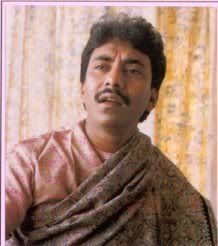
Rampur-Sahaswan is a gharana of Hindustani classical music centred in the Uttar Pradesh towns of Rampur and Sahaswan. The history of this gharana begins with Inayat Hussain Khan (1849-1919). He was the son of Mehboob Khan, a khayal singer and Veena player of the Rampur court. Mehboob Khan is said to have performed khayals in a simple style with an emphasis on tappa style taans, which can be taken to be an indication of his affiliation to the Gwalior khayal gharana. He was also a beenkar and veena player. Inayat Hussain Khan had a cousin, Haider Khan, whose grandson was Nissar Hussain Khan (1906-1993). Inayat Hussain Khan is said to have shown unusual singing talent in his childhood and so his father took him to the chief court musician of the Rampur court for further training.
So as Inayat Hussain Khan, the founder of the gharana, hailed from Sahaswan and was trained and lived in Rampur, the gharana came to be called Rampur-Sahaswan. Inayat Hussain trained his son Sabir Hussain and his son-in-law Mushtaq Hussain Khan (1874-1964). It is through the styles of his sons-in-law that contemporary experts have formed their idea of the Rampur-Sahaswan style and it is through his sons-in-law that the gharana stays aloft today. Like the sons-in-law, Inayat Hussain's three daughters, naturally played a big role in keeping the gharana alive. The youngest daughter Sabri Begum gave birth to leading senior contemporary exponent Ghulam Mustafa Khan and daughter Shakhri Begum. Shakhri Begum gave birth to Rashid Khan, the famous vocalist.
Mushtaq Hussain Khan - Meera Bai Ki Malhar :
Nissar Hussain Khan - Puriya Dhanashree :
Ghulam Mustafa Khan - Pilu - Ghir Ke Aayi Badaria :
Rashid Khan - Alahiya Bilawal - Sumiran Kar Man :
The renowned singers of this gharana include Mushtaq Hussain Khan, Nissar Hussain Khan, Ghulam Mustafa Khan, Ghulam Sadiq Khan, Rashid Khan, Ghulam Abbas Khan, Begum Shanno Khurana and Sulochana Brahaspati.
Presented in this post are a few gems from some of the most renowned artists of Indian classical music. These songs were picked up by me from various music forums and sites. A couple of these songs have been specially uploaded on visitors' requests. If your requested song is not here, please wait for the next Random Songs post.
Bhimsen Joshi - Thumri Bhairavi - Babul Mora Naihar :
Here are some more songs of my choice and liking. A few gems from my favourite playlist. All the vocalists are renowned names. Firoz Dastur (1919–2008) was a well known, and probably the most successful, Hindustani classical singer from the Parsi community.
Firoz Dastur - Thumri Kafi - Bawre Dam De Gayo Kanha :
Bhimsen Joshi - Thumri Tilang - Kahe Ko Neha Lagaye :
It has been my endeavour all along to provide a download link for all the songs that I post on this blog, so that you may soak into the music at your leisure. However, I must tell you in clear terms that all these uploads have been deliberately encoded in a very lo-fi quality and are meant for sampling purpose only. As such, these songs can be best heard on a desktop computer or laptop speakers only. Any attempt to load these songs on your iPods or playing them on a high fidelity audio system could harm not only your precious ears with high static and crackle, but also the commercial interest of our striving artists. So if you like the music posted on this blog, please buy the original CDs. Don't hesitate, gather enough courage and go for it. I bet, you won't be disappointed. It would be a proud moment for all classical music lovers, and a dream come true for the artists, to see at least one Bhimsen Joshi CD along with one of Himesh Reshamiya, lying side by side on the CD rack, in all homes of the subcontinent.
Based upon visitors' requests and also the 'search words' that led people to this blog, here are a few more songs, specially posted for you.
Begum Akhtar - Dadra - Hamari Atariya Pe :
Bhimsen Joshi - Bhairavi - Boli Na Bol Humse Piya :
Indian classical music is basically split into two branches. The northern Hindustani tradition, influenced by the musical traditions of the Mughals, and the southern Carnatic tradition which largely remains culturally devotional in nature. To Westerners, and to many even in India, Indian classical music is simply a melody without a specific beginning or a definite end. To them it is more a gymnastics in sound, and to a few, unnecessary flexing of the vocal chords. As such, to many, its technicalities seem a little too baffling. A little basic knowledge about various sections of a recital is necessary, before one may start appreciating Indian classical music.
Probably the most striking difference between the Western and Indian classical traditions is the importance of improvisation in the latter. While Western music has written scores, an Indian classical performance is extempore. The overwhelming majority of Indian recitals are improvised on the spot, making each performance unique and unrepeatable. The musicians may almost never have practiced together, and it may be unusual for any musician other than a soloist to have a clue what will be performed. Given this, it is mind boggling to see the speed with which incredibly complex Ragas are improvised by the performers, with vocalists, instrumentalists and percussionists engaged in creating an unified interaction of rhythm and melody that is precisely calculated to bring out the essence of the Raga and mood, set out in the composition.
The improvisational nature of Indian music requires the artist to take into consideration the setting, time allowed for his concert, his mood and the feeling he discerns in the audience before he begins to play. The traditional recital begins with the Alap section - the serene exploration of the chosen Raga. Just like an hors d'oeuvre (appetizer) served before the main course of a meal. After this slow introspective beginning, the musician moves on to the Jor. In this part, the basic theme of the Raga is elaborated and the artist tries to bring the emotional mood of the Raga to the surface. There is no drum (Tabla) accompaniment in either Alap or Jor.
The Alap and the Jor evolve into the Gat or Bandish, the fixed compositions of the Raga. The Gat is divided into two parts called Vilambit and Drut. Vilambit is set to a slower tempo, while Drut is the fast composition. Here the drums enter with the rhythmic structure of the Gat and its time cycle, the Tal. The step-by-step acceleration of the rhythm in the Gat finally culminates in the Jhala, the final movement and the climax of the Raga. Here the music becomes more and more playful and exciting. Often, in vocal music, the artist erupts into a Tarana, a type of composition in Hindustani vocal music in which certain meaningless words and syllables (e.g. 'todani', 'tanaderena' etc) are used in a medium paced (Madhya) or fast (Drut) rendition. It was invented by Amir Khusrau and is now common all over India. Carnatic music has something similar called Thillana which is widely used in dance performances.
At the conclusion of a recital, the musician may choose to play a Thumri or a Dhun. This is a variation of Indian classical music, evolved during the Mughal rule. Here the artist has freedom to go beyond the scale of the Raga.
P.S : As I have always believed in giving my visitors, the play and download option for all songs, no wonder I am faced with a serious bandwidth issue. As a result some files in my older posts may not play or download. However, irrespective of this problem I will try to continue posting more songs. Thanks for your patience.
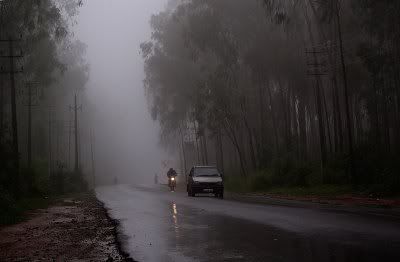
The Raga, Malhar is a powerful legendary Raga in Indian classical music. Raga Malhar is associated with the atmosphere of torrential rains. There are many written accounts and legendary tales about Raga Malhar. According to the legend, Raga Malhar is so powerful that when sung, rain starts falling from the sky. Many great artists of the medieval, and much earlier period used to sing this Raga to invoke the Rain God. Tansen, Baiju Bawra, Mahanvilas Kanh (son of Tansen) and Meera are among the singers, who are said to have been capable of invoking rains, by singing various forms of Raga Malhar.
With certain parts of North and Central India reeling under intense heat and the monsoon still eluding the people living there, the Malhars posted above may bring some soothing, if not cooling, effect.
QUIZ : Give me the names of the male and female singers and the name of the Album/Film, and I will send you this rare song + a bestseller e-book (in Microsoft Reader .lit format) by email. Answer the questions in the comments to this post, and please don’t forget to mention your email address.
Rashid Khan had truly arrived on the classical music scene when Pandit Bhimsen Joshi heard him at a concert in early 1988. "There is now at least one person in sight who is an assurance for the future of Indian vocal music", said Pandit Bhimsen Joshi, voicing the concern of connoisseurs of Hindustani vocal music about whether its tradition of excellence would continue.
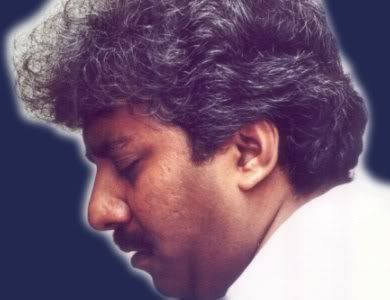
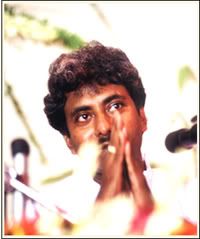
Rashid Khan, blessed with a deep rich and powerful voice is often hailed as the greatest vocalist alive. His uncanny ability to capture the essence of a raga is unmatched. His taans are so virtuous that one must hear them to believe them.
Another installment of songs that I picked up from here and there, while surfing the web. For the first time, I am not giving you the download links due to bandwidth restriction on the respective servers. You may however, fish out these files from the Internet Explorer Cache after playing them to their full length :
Rashid Khan - Raga Jogkauns - Peer Parayi Jane Nahi : (Download)
Being an ardent fan of Rashid Khan, maestro of the Rampur-Sahaswan Gharana, I can't resist putting more songs of him on this blog. He is one of the best among the contemporary vocalists and his effortless singing and silk like voice just keeps me spellbound.
Gorakh Kalyan - Tum Bin - Kab Ghar Aayo : (Download)
Kiravani - Brij Ke Nandlala Tore Bina Mohe Chain : (Download)
Malkauns - Tu Hai Malik Mero - Yaad Aavat Mohe : (Download)
Rashid Khan, born in 1966, is perhaps the most convincing proof of what miracles the revived Gurukul system can achieve. Under the tutelage of Ustad Nissar Hussain Khan, the Sahaswan Gharana maestro, for the last ten years in Research Academy, Calcutta, Rashid has metamorphosed from a gawky, groaning child to an artiste of unbelievable maturity, vocal prowess and artistry.
Rashid's alap is ticklishly imaginitive, his rhythmic play pulsating and the cascades of his powerful, lightening, swift taans unimaginable until actually heard.
Rashid has naturally taken listeners and the Press by storm wherever he has gone, and at a conference at Bhubaneahwar in 1982, a member of audience was so overwhelmed by the uncanny expertise of the young boy that he promptly made him a gift of one thousand Rupees.
In 1986 the Festival of India authorities invited Rashid Khan to present the only music recital on the occasion of the release of Double Album on Great Masters of Music by the then Prime Minister of India, late Rajiv Gandhi. The concert was intended to signify the continuance of the tradition of excellence in Indian classical music.
Rashid Khan was awarded the 'A' Grade by All India Radio in 1987. In 1988 he cut his first record. Doordarshan has produced and telecast a special programme on this phenomenon. In 1989 Rashid Khan made an extensive tour of the United States and Canada, taking, as usual, crowds by storm.
Rashid Khan has been hailed as a great successor to the Bade Ghulam Ali Khan - Ameer Khan generation - an era today almost given up as lost. He had truly arrived on the scene when Pt. Bhimsen Joshi heard him at a concert in early 1988 and proclaimed that there is now at least one person in sight who is an assurance for the future of Hindustani Vocal Music.
Listen to this composition sung by him in Raga Jaijaivanti from his album 'Mercy Rain' :