As we all know, Indian classical music is mostly based on the seasons of the year and even fine tuned to the hour of the day. Chaiti is sung in the month of Chait that falls in March or April as per the Hindu calendar. The Chaiti is a musical form derived from folk songs and its theme mostly revolves around romanticism and mood of love. These are certainly season specific songs. The Chaiti songs, like Kajri, have a place in semi classical form also. Most of the songs have wordings like Ho Rama or Are Rama. The lyrics are normally in the Purabi dialect, spoken in eastern Uttar Pradesh and parts of Bihar.
No festival of India is such an important constituent of our traditional classical and folk music as Holi. This festival of colors, is one that adorns our lives with the synergy of celebrative air and music. This joyous festival is in tune with the gaiety of the spring season when this festival is held. The windswept, withering, winter scene is truly dabbed away with the vibrant colors of blossoming flowers heralding spring, a time for the earth to rejuvenate. The refreshing southern breeze successfully chases out the chilly northern wind, in the Hindu month of 'Phalgun'. The fervor, fun and frolic of the festival reflect the essence of harvest and hope.
Ajoy Chakrabarty - Aaj Phagua Mein Hori Machi Hai :
Girija Devi & Shobha Gurtu - Bhijoyi Mori Chunari :
Ghulam Mustafa Khan - Piya Sang Khelun Hori :
Channulal Mishra - Barjori Karo Na Mose Hori Mein :
P.S : As I have always believed in giving my visitors, the play and download option for all songs, no wonder I am faced with a serious bandwidth issue. As a result some files in my older posts may not play or download. However, irrespective of this problem I will try to continue posting more songs. Thanks for your patience.
Last century saw a distinct shift for women singers of hindustani classical music. From being the preserve of the bais and courtesans in the past, it gradually grew into an honorable profession to the young girls and women of respectable families. Women singers of today are not only admired, but seen with awe, and rightly so. Women classical singers in fact, never had it so good.
With this post I begin a new mini series of songs by some of our great women singers, each one a Diva in her own right.
Yet another very good, but not very popular resource of hindustani classical music is pz10.com (the pz stands for Punjabi Zone). The reason it being not too well known in the classical music circuit is, it's rather unfriendly interface and strange indexing system. But, once you get the real feel of the site it could prove to be a true bonanza to all music lovers. One good thing about this site is that it streams it's music in both .wma and .mp3 formats. Moreover, the mp3s are of 128 Kbps (near CD) quality, which is good enough reason to download from this site.
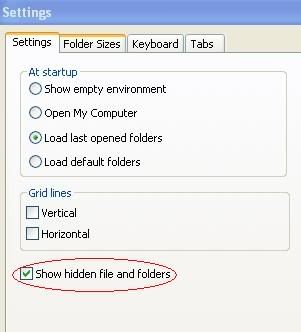
To music lovers for whom retrieving music from the Internet Explorer Cache is becoming a habit, I recommend they install ExploreXP (click here to download), a very small and free alternative to Windows Explorer which is easy to setup and can be configured to view all hidden and system files. Moreover it lets you view the filesize in Bytes rather than KBs which is the standard view in Windows Explorer.
Before attempting to download, clean your Internet Explorer cache completely, by either using the standard method of Start > Programs > Accessories > System Tools > Disk Cleanup, or by using an utility like CCleaner or even Index.bat (a batch code written by me for those who know their way around with the Command Prompt and Safe Booting).
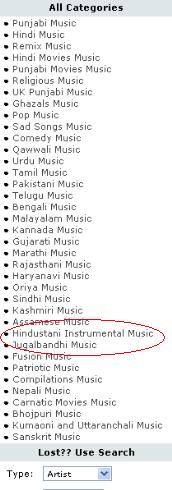
Visit the music section of pz10.com. Click on the Hindustani Instrumental Music (its more than just instrumental really), and then on the View / Browse All Hindustani Instrumental Music Albums (or simply click here).
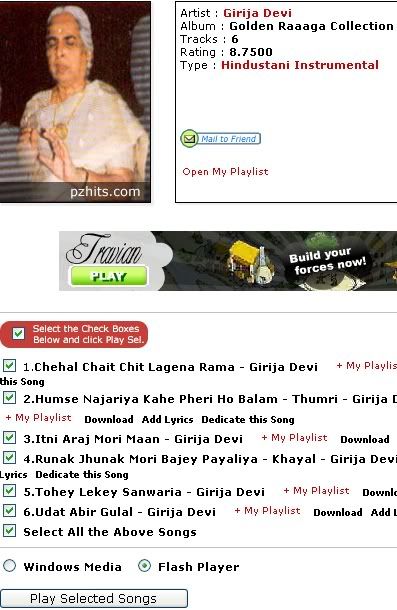
Choose the album you want to download.
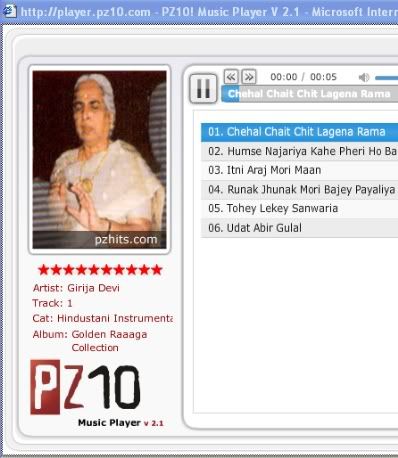
Choose Flash Player, Select All Songs and click on the Play button. Let the songs play to their full length.
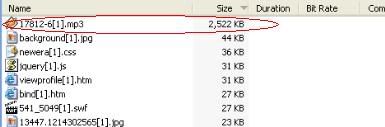
Inside the IE Cache, the song file will start to grow as it plays on :
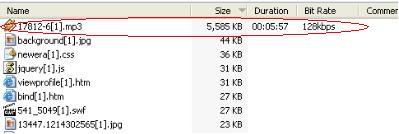
After the caching is complete :
Retrieve the songs from the Internet Explorer Cache. ExploreXP will help you to do it with ease.
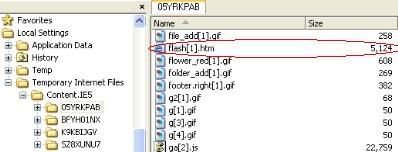
Another way to download is to search for flash[1].htm file in the cache which is the playlist file (this is tricky because sometimes it could be a jumbled 8 character name like CAX8KNTH.htm). If you are using the Windows Media Player as your player option, the playlist file will be named playlist[1].htm.
Open the file in notepad and copy the song URL (highlighted part) which looks like this :
Use a downloader like Flashget to download the file.
Note: The voxtoken=(+ a combination of letters and numbers) is a part of secure webcasting code by Voxel meant to prevent the users from downloading the music. As the voxtoken code changes every time you load the player, so does the URL of the song, preventing people from posting the songs on their blogs or elsewhere. This means, the URL is good enough for single use only.
The pz10.com team has a sense of humor too. An attempt to open the flash.asx (seemingly a playlist file, the path is mentioned in flash[1].htm), will give you this mocking message :
NO SOUP FOR YOU SHAME SHAME!!!!
Well, here is a spoonful, (of soup ?) for everyone to savour.
Apart from a sizeable collection of hindustani classical music, pz10.com also has a good number of regional songs including Bhojpuri and Rajasthani folk.
Holi is one of India's most vibrant and fun-filled festivals and it has a unique style and form in each part of the country that is reflected in the music that is associated with the festival. The musical forms associated with Holi vary from region to region as one travels from the north-west to extreme east of the country, down to the southern region. Primarily though, the compositions are based on the mythological references and tales from folklore.
Abida Parveen - Holi Khelan Aaya Piya : (Download)
Shobha Gurtu - Aaj Biraj Mein Holi Hai Rasiya : (Download)
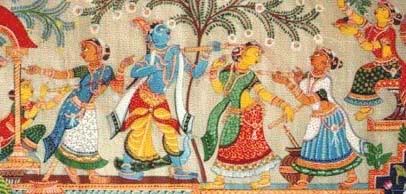
HoRi is the most popular type of Dhrupad sung on the festival of Holi. The compositions here describe the spring season. These compositions are mainly based on the love pranks of Krishna and Radha. Interestingly it has both classical as well as semi-classical connections. Horis sung as a concluding portion of a Dhrupad recital are classical in nature as well as treatment. Those Horis, which are sung in semi-classical form, are in ragas like Khamaj, Kafi etc. Significantly, these horis are also set to a tala of 14 beats called Deepchandi.
Very few accomplished women singers have sung together and complimented each other so wonderfully, as Girija Devi and Shobha Gurtu in the four songs that I am posting today. Girija Devi being from Varanasi excels in the 'Purab Ang Gayaki and Tappa' whereas Shobha Gurtu has immortalized herself as the 'Thumri Queen' of her time. In these songs notice how each singer gives the other one enough space to present her own trade mark style and adapt to each other so well. These are such immortal Jugalbandis which I would always love to hear anyday and anytime.





 raga bhimpalasi



