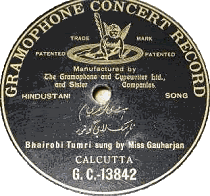
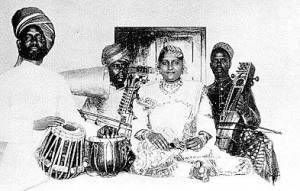
The first ever Indian voice was recorded by Fred Gaisberg in London in February 1899. These were 7 inch records with recording on one side only. Some 44 recordings, were made in Hindi, Urdu, Bengali and Punjabi. None of these records have been found by the collectors. In 1900 the population of India was approximately 234 million. The inhabitants spoke more than twenty different languages and hundreds of dialects, and had a musical culture reaching back several thousand years. This potential market led to three major recording tours by Gramophone Company experts between 1902 and 1908, led by Fred Gaisberg, William Sinkler Darby, and Will Gaisberg.
Gauhar Jan of Calcutta :
On November 14, 1902, the first recording of Hindustani classical music was engraved in the grooves of a gramophone record. A very rudimentary and makeshift recording studio had been set up in two large rooms of a hotel in Calcutta by the Gramophone Company. Gaisberg visited several theaters, attended mehfils at wealthy Jamindars' palaces, and thus found at least one promising artist to begin with. The artist was a very famous dancing girl, although her voice was not so sweet for European ears. She agreed to a recording session for the handsome fee of Rs. 3,000. Her name was Gauhar Jan.
Gauhar Jan of Calcutta - Bhairavi Thumri (1902) : (Download)
Zohra Bai of Agra - Matki Mori (1905) : (Download)
Zohra Bai of Agra - Paraj Tarana (1905) : (Download)
In the beginning around 1902, many artists recorded songs in Calcutta. The artists were either 'Nautch Girls' (dancing girls) or women under the patronage of kings and wealthy landlords. They belonged to Agra, Lucknow, Allahabad, Benares, Calcutta, and Delhi. Later on celebrity dancing girls like Janki Bai of Allahabad, Zohra Bai of Agra, Malka Jan of Agra recorded prolifically for the company. During 1902-1908, recordings of over 8-10 very famous artists helped in establishing the business in India. However, these are almost forgotten now. Here is an attempt to acknowledge these noted female singers of that period. The songs may not be good examples of the art of classical singing, but are of historic importance.
Janki Bai of Allahabad :
Malka Jan of Agra - Maro Pichkari (1906) : (Download)
Janki Bai of Allahabad - Fana Kaisi Bana (1908) : (Download)
Janki Bai of Allahabad - Medicine Men (1908) : (Download)
In order to have recorded documentation for making paper labels, the artists were asked to announce their names in English at the end of singing. This helped the technicians in Germany in making the final records ready for sale. All the songs posted above have the announcement at the end. This continued for two more recording expeditions and about 3000 wax records were made, pressed in Germany and brought back to India for marketing.
Master Madan (1927-1942), a child prodigy (not to be confused with music composer Madan Mohan), died at the young age of 14 years, sang only a few songs which are everlasting and embedded in perfection. During his lifetime he recorded only 8 songs. Of these, only two Ghazals are available publicly. These are the famous,'Yun Naa Rah Rah Ke Hame Tarsaiye'* and, 'Hairat Se Tak Raha Hai'*. The other six songs are very rarely found, and of great archival value. In this post I present to you, all the 8 songs ever recorded by him.
Master Madan was born on December 28, 1927, in Khanna, a village in Jalandhar district of Punjab. He sang in public for the first time when he was three and a half years old, in a rally arranged by Dharampur Sanatorium. The audience was understandably spell bound. He was given many gold medals right there and then. After that he and his elder brother toured all over India and collected many prizes from the rulers of many princely states. They sang in the famous Harvallabh Mela of Jalandhar city and later in Shimla. Reportedly, in the Shimla Sammelan, many notable singers had also come, but thousands were eager to listen to Master Madan only.
At the age of eight, he was a famous radio singer, singing mainly on Delhi radio station on Alipur road. His final public program took place in Calcutta at age 14. He sang, 'Vinati Suno Mori Avadhpur Ke Basiya' for 90 minutes with such beauty that the public refused to go home. One patron respectfully offered Rs. 500, a princely sum in those days, on his feet. Also 9 gold medals were announced by various patrons to be given to him. In those days, gold medals were really made of gold. He returned to Delhi and kept going to the Delhi radio station for about 3-4 months. Soon he started getting sick. Many remedies were tried but nothing helped.
Punjabi Song - Bagaan Vich Pingan Paiyan : (Download)
Punjabi Song - Raavii De Parle Kande Ve Mitara : (Download)
In the summer of 1942, he went to Shimla, where his forehead, and joints started to shine unusually. He died on June 5, 1942 suffering a great deal of pain. It was suspected that he died of mercury poisoning. It is believed that a jealous singer gave him mercury in his milk. On his death, Shimla closed down and a huge gathering accompanied him on his last journey.
November 14,1902 : A very rudimentary and makeshift recording studio had been set up in two large rooms of a hotel in Calcutta by the Gramophone Company. Frederick William Gaisberg and his assistants had arrived just three weeks before from England on their first Far East recording expedition for the Gramophone Company, which had been founded in England in 1898. They had appointed a local agent for selecting and training artists for recording on gramophone discs. However, the agent selected Anglo-Indian artists and completely ignored local talent. Gaisberg then sought the help of the local Police Superintendent, visited several theaters, attended mehfils at wealthy Jamindars’ palaces, and thus found at least one promising artist to begin with. The artist was a very famous dancing girl, and her voice was very sweet, although not for European ears. She agreed to a recording session for the handsome fee of 3,000 rupees. Such an artist was necessary in order to build a firm business foundation on the Indian scene, especially when several other German, French and American recording companies were also planning to capture the Asian market in general and the Indian market in particular.
At around 9.00 a.m. a young lady entered the studio with all her paraphernalia, including accompanists and relatives. Loaded fully with very expensive ornaments and jewelry, this 30 year old, fair, medium-built lady went onto the stage prepared for the recordings. Sarangi, harmonium, and tabla players began to tune their instruments. Gaisberg personally checked the equipment. A thick wax master record was placed on the turntable rotating at 78 rpm. A huge recording horn was fitted on the wall behind her and close to her face, and she was asked to sing loudly into the horn. At the narrow end of the long horn a diaphragm fitted with a needle was connected to the recording machinery, with a needle placed on rotating disc for cutting the grooves. Gaisberg requested her to sing for three minutes and announce her name at the end of the recording. At the end of the trial recording she announced - 'My name is Gauhar Jan'. This announcement was necessary since the wax masters were sent to Hanover in Germany for pressing the records and the technicians would make proper labels and confirm the name by listening to these announcements at the end of the three minutes performance.
Although sound recording was invented by Thomas Alva Edison in 1877, it took 20 years for the technology to mature, and after 25 years, in 1902, the first ever recording of Indian classical music was engraved in the grooves of a gramophone record. The song can be played even today in 2007 on a shellac record and Gauhar Jan will sing it faithfully for the music lovers and listeners as long as the technology to play back that singing exists. Who was this Gauhar Jan - the first dancing girl of Calcutta ?
Born to Anglo-Indian parents, her name was Miss Angelina Yeoward. Her father, William Robert Yeoward, was an Armenian Jew working as an engineer in a factory producing dry ice at Azamgadh near Benares. He married a Jewish lady, Miss Victoria Hemming, around 1870, who was born and brought up in India and had learnt Indian dance and music. Angelina was born in 1873 and was baptized in the Methodist church in Azamgadh. This marriage did not last long due to Victoria’s love for dance and music and her relations with a Muslim friend named Khurshed. So after the divorce, she moved to Benares with Angelina and Khurshed, adopted Islam as her religion, and daughter and mother chose new names, Gauhar and Malka respectively. In those days, Benares was not only a sacred place, but also a seat of learning, a centre for all the performing arts, including dance, drama and music. She spent eight years learning the art to perfection and emerged as a well-trained Baiji, as she had decided to take up the profession of entertainer through dance and music. She became popular as Badi Malka Jan, badi (elder) because at that time three other Malka Jans were famous (viz. Malka Jan of Agra, Malka Jan of Mulk Pukhraj and Malka Jan of Chulbuli) and she was the eldest among them.
Around 1883, the trio moved to Calcutta, a place of great patronage for music and the other arts. In those days, both Hindu and Muslims Baijis from Benares, Agra and Lucknow used to settle in the Bow Bazaar area. The place was famous for courtesans or Kothewalis who would entertain wealthy Jamindars and Babus with their art. Some Ustads would train this community after a proper gandabandhan. Nawab Wajid Ali Shah had settled at Matiaburj near Calcutta in his last days and his court was full of musicians and artists. In such an atmosphere Badi Malka Jan soon established herself, and within three years she purchased a building at 24 Chitpore Road for Rs. 40,000. Little Gauhar, too, was fond of dance and music and took her initial lessons from her mother. She had a sharp memory, intelligence and learned very quickly, and so Malka appointed special teachers for teaching Gauhar languages, literature, and of course, dance and music. Kale Khan of Patiala, alias ‘Kalu Ustad’, and Ustad Vazir Khan of Rampur trained her in pure and light classical Hindustani vocal music, whereas Ali Baksh and Brindadin Maharaj taught her the Kathak form of dance. Srijanbai taught her dhrupad dhamar, and Charan Das trained her in Bengali Keertan. She also learnt from her contemporaries, viz. Mojuddin Khan, Bhaiyya Ganpatrao and Peara Saheb. She sang Tagore songs even before the word Rabindra-Sangeet had been coined. She penned several compositions under the name ‘Hamdam’, and she also wrote, composed and recorded ghazals. She could read, write and sing in several languages including Bengali, Hindustani, Gujrati, Tamil, Marathi, Arabic, Persian, Pushto, French, Peshawari and English.
After such intensive training, she first performed at Darbhanga State at the age of fifteen, and from 1896 she began to perform in Calcutta. She used to sing and dance at the houses of rich jamindars and her remuneration was in thousands of rupees. She was in great demand and even ordinary citizens wanted to listen to her music. Gaisberg noticed this and made her music available to listeners through her gramophone records. Gauhar Jan recorded prolifically, a total of over 600 songs over the period from 1902 to 1920, and she sang in more than ten languages. From 1903, her records began to appear on the Indian market, and were always in great demand. Thousands of copies were imported after being pressed at Hanover, and they were best-sellers throughout India. In 1908, a record-pressing factory was built at Sealdah (close to the present Sealdah railway station), Gaisberg was invited for this occasion and recorded a few more songs of Gauhar Jan, for which the announcement of her name at the end was not required.
The early records of Gauhar Jan are labeled ‘First dancing girl, Calcutta’. The word ‘first’ indicates her elevated position as the premier vocalist in the Calcutta's musical world of 1890-1910. She cut records of raagdari sangeet, thumri, dadra, kajri, chaiti, bhajan, tarana and she popularized various types of ‘Kachha’ gana through her records. This was remarkable when several great stalwarts of Indian classical music ignored the gramophone and recording medium completely and refused to record. She mastered the technique of presenting a musical item in just three minutes, and this became a model for the vocalists of the future. She recorded the music taught by her Ustads, which meant that she helped preserve our musical tradition of at least the three-four generations preceding her own. Thus her recordings are very useful for students and also for researchers who might wish to trace the development of Indian classical music over the last two or three hundred years. One of her records was cut in 1907, performed at the Town Hall in Bombay, as mentioned on the record label.
Through the wide circulation of her records, she became popular throughout India and received invitations in several prestigious music conferences. Thus in 1911, she was invited to participate in the Prayag Sangeet Samiti, for which she was paid 1000 rupees. Later, the same year, during the coronation of King George V at the Delhi Darbar, she was invited to sing a duet with Jankibai of Allahabad. They sang a Mujra song - Ye Hai Tajposhi Ka Jalsa, Mubarak Ho Mubarak Ho and received 100 guineas each as a gift from the King.
Gauhar Jan used to travel all over India, as a guest of patrons in the various Princely states. She also gave public performances, in which she would present ticketed programs, distributing an advance schedule of the items to be sung in her concert. She was fond of horse-racing and hence would visit Bombay during the racing season. She used to stay with Anjanibai Malpekar, spending the day at the Mahalakshmi racecourse, and the evenings and nights at concerts. She was a great admirer of Heerabai and offered to adopt her when Abdul Karim Khan’s family separated and the mother moved to Pune with her five children. She taught a number of bhajans and thumris to both Heerabai and Sunderabai, which they in their turn duly recorded on gramophone records. Because of Gauhar Jan the songs Radhe Krishna Bol Mukhase and Kridhna Murari Binat Karat became popular bhajans and several singers used to sing them in concerts and on records.
Gauhar Jan lived a very wealthy life, and she also donated generously to a number of causes. Numerous legends are associated with her. In Calcutta, she used to ride in a baggi driven by four horses, threw a party spending 20,000 rupees when her cat produced a litter of kittens, and donated only half the promised amount to Gandhiji’s ‘Swaraj fund’ when he did not keep the promise of attending the ‘fund raising’ concert and deputed a representative instead. In her personal life, she was deceived by her friends and relatives. She married her personal secretary - Saiyyad Gulam Abbas - a young man from Peshawar. He was ten years younger than her, and when she discovered his relations with other women, she was bitterly disappointed in him, and this led to several court cases and unpleasant incidents. Later, she stayed with Amrut Vagal Nayak in Bombay - a handsome actor on the Gujrati stage. This relation lasted for 3-4 years, and she learnt several songs composed by him including the famous Dadra, Aan Ban Jiyamen Lagi. The sudden death of Amrut Nayak was a big jolt that left her mentally disturbed. Relatives persuaded her to return to Calcutta. But she did not stay there long. The machinations of selfish and cunning relatives forced her to stay in Darbhanga State for a while. Finally she joined the service of the Mysore State, where she died in 1930.
She has left over 150 records and most of them are in the safe custody of record collectors. The Gramophone company reissued 18 songs in 1994 on audio tape and CD under the banner of ‘Chairman’s Choice’, which no one (except perhaps the Chairman) noticed, due to lack of adequate publicity. It is necessary to preserve the legacy of Gauhar Jan in a more full-scale way for posterity, and some die-hard collectors and music lovers have committed themselves to accomplishing this task.
Here is one of those early recordings...listen to her announcing her name in the end..."My name is Gauhar Jan" :