Showing posts with label benares. Show all posts

Friday, June 04, 2010

Bismillah Khan : piper of Benares

Ustad Bismillah Khan (1916-2006) was perhaps single handedly responsible for making the shehnai a famous and popular instrument and bringing it into the mainstream Indian classical music. He was credited with having almost monopoly over the instrument as he and the shehnai were almost synonymous. Bismillah Khan was born in a small village called Dumraon in the state of Bihar, on November 21, 1916. His early childhood was spent in Benares, on the banks of the Ganga, where his uncle was the official shehnai player in the famous Vishwanath temple. His father was a musician for the Dumraon state.


He started his training under the guidance of his maternal uncle, Ali Bux, at the age of six. He often accompanied him to perform at marriage celebrations or music conferences. Bismillah Khan made a recording for the first time in 1930. However it was sold in the name of a relative, Vilayat Hussain, a more popular musician at the time. He made his first major public appearance in 1930 at the age of 14, when he played along with his uncle at the All India Music Conference in Allahabad. His second performance was at the Music Conference at the Lucknow exhibition, where he won a gold medal for his recital.

Bismillah Khan - Kajri Keharwa :  Download


Bismillah Khan - Chaiti Dhun :  Download


Bismillah Khan - Thumri Bhairavi - Aaye Na Balam :  Download


Bismillah Khan - Dhun (from the film 'Goonj Uthi Shehnai') :  Download


Bismillah Khan - Dhun - Raghupati Raghav Raja Ram :  Download


Bismillah Khan had the ability to produce intricate sound patterns on the shehnai which, till before his time, were considered impossible on this instrument. The Government of India bestowed on him the title Padma Shree in 1961, and later, the Padma Bhushan and the Padma Vibhushan. In 2001, he became the third classical musician to be awarded the Bharat Ratna, after M S Subbulakshmi and Pandit Ravi Shankar. Bismillah Khan died of cardiac arrest on August 21, 2006. He was 90. The Government of India declared one day of national mourning on his death, an event unprecedented for any musician.

Thursday, April 30, 2009

Street Music of India

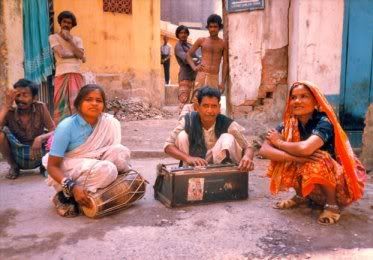
During our growing years, we Indians are exposed to a lot of rural folk as well as urban street music. It is noticed that the amorphous nature of music has given rise to an unique amalgam of folk music and popular cinema sounds, being performed by musicians on stages and arenas, depicting the cultural experience of urban life and the streets. One can easily relate street music with the multi-dimensions of street culture.


There is an evident cross fertilisation between the two musical forms, with both taking from, and responding to the other. The Indian film music industry has a strong influence on popular Indian culture and while it has shaped public preferences, it has also borrowed from classical music forms. One common belief about street musicians is of them being too lazy to get a 'real' job, harassing people on the streets with 'inferior' or 'crude' acts to solicit money to support a degenerate lifestyle. This perception is not confined to this part of the world only.

Bhajan from Benares :  (Download)


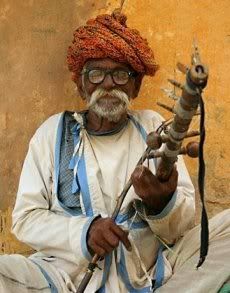
Tribal Song from Rajasthan :  (Download)


Nautanki Song from Kanpur :  (Download)


Street music is perceived as a 'lesser' performing art, an illegitimate musical form. However, it continues to endure this viewpoint, surviving elitist ideas of 'high' art. Moreover, street music is being increasingly absorbed into mainstream musical forms but without recognition. Lack of recognition of this art form, deprive the artists of social and economic benefits that are rightfully theirs.

Jogi Song from Gujarat :  (Download)


Bhajan from Orissa :  (Download)


Baul Song from Bengal :  (Download)


Beggar's Song in a Street :  (Download)


The homespun, creative and intelligent construction of musical instruments made by the artists themselves, mirror the many dimensions of the artist. Streets and their culture lie at the heart of public life in contemporary India, especially in cities where urban housing is crowded and uncomfortable. Its streets act as thoroughfares, bazaars, theatres and most of all, a setting whose culture is constantly changing and evolving with time.

Comments are welcome.

Wednesday, October 22, 2008

Voices along the Ganges : Chants & Folklores

Before commencing any further, a small 'statutory' warning. Please do not blame me if you find the links to the mp3 files in my posts to be dead, sooner or later. I do not know of a site that has hosted it's music files for more than a few years. The web is abundant with dead mp3 links. Already many of the songs that I had put in my previous posts have been removed by their host servers, and visitors on my blog have been sending me frantic complaints.

Amusingly mp3 files are like orphan kids, living on the streets, forever yearning for a permanent abode. They are more often than not, shunned after a few days of shelter offered by a kind soul. Ironically mp3 files are the most sought after but also the most hounded after files, always being chased by copyright laws. At first loved, then hated and feared by the webmasters, mp3 files are almost treated like live bombs amidst peace loving net-citizens. So don't be surprised, if you wake up one fine morning and find the links not working anymore and the files gone forever.


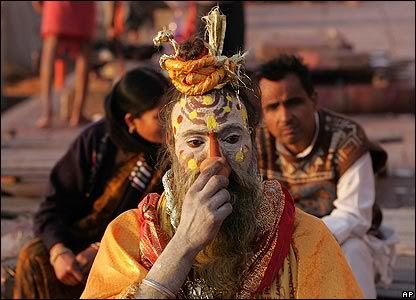
Continuing our journey along the holy river of Ganges, we arrive at Benares (Varanasi), the holiest city of the Hindus. The significance of Benares lies not only in the fact that it is considered so holy, but in the fact that it embodies the Hindu philosophy of death. Death for the Hindus is just one step forward in the endless cycle of birth and rebirth. And believers come to Benares to die or to cremate their departed relatives, believing that Lord Shiva himself whispers words of salvation into the ears of the dead here.

Benares - Nirgun Pad : (Download)


Benares - Hori in Raga Mishra Kafi : (Download)


Benares - Birha : (Download)


These words of salvation, Hindus believe, free their souls from the cycle of birth and rebirth, granting them moksha. Nowhere else do death and life coexist so closely as they do in Benares. Boatmen row, beggars beg, bathers bathe, and pilgrims pray.


The largest tributary to the Ganges is the Ghaghara, which meets it before Patna, in Bihar, bearing much of the Himalayan glacier melt from Northern Nepal. The Gandak, which comes from near Kathmandu, is another big Himalayan tributary. Other important rivers that merge with the Ganges are the Son, the Gomti which flows past Lucknow, and the Chambal made notorious by the ravines in its valley which are noted for lawlessness and banditry (including the infamous Phoolan Devi).

Patna - Pachra Chant : (Download)


Patna - Kilona (Chant to a Child) : (Download)


The journey along the river Ganges will continue...

.. more Voices along the Ganges »

Enjoy !!