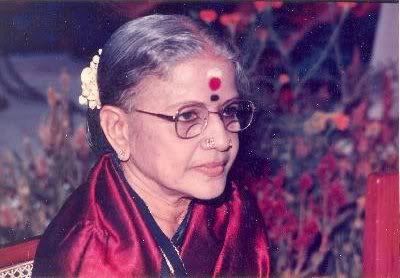
Madurai Shanmukhavadivu Subbulakshmi (1916-2004) has been the queen of Indian classical music in the South Indian Classical style (Carnatic) in the modern times. From Mahatma Gandhi to the most common of the people have admired her voice, conditioned perfectly to render some of the great Indian works of devotional literature. Her 'Suprabhatam' is like staple music in temples all over south India.
With her rock-solid technique, sure tone, deep spirituality and splendid emotional expression, M S Subbulakshmi was rightfully considered an Indian national treasure during her lifetime. Thanks to a legion of great recordings, her place among the great vocalists of the 20th century is assured.
She was born in 1916 in the temple city of Madurai, Tamil Nadu, to a family of famous instrumentalists. While still quite young, she began Carnatic musical training with Madurai Srinivasa Iyer and briefly studied Hindustani music from Pandit Naryan Rao Vyas.
Surdas Bhajan - Maiya Mori Main Nahin Makhan : (Download)
Surdas Bhajan - Bujhat Shyam Kaun Tu Gori : (Download)
She debuted as a soloist at 17, and with the full support of her husband Thiagarajan Sadavisam (whom she married in 1940), she began acting and performing in films. Her most famous film was 1945's Meera, in which she portrayed the revered medieval poet-saint Meerabai and sang several popular Meera bhajans (Hindu devotional songs attributed to Meerabai). After the huge success of Meera, however, Subbulakshmi turned her career entirely away from films.
While she was an extremely popular performer throughout India, she did not appear abroad as often as other Indian artists of similar renown. However, she did appear at New York's Carnegie Hall in 1977 and at London's Royal Albert Hall in 1982, among other high profile venues.
An intensely devout person, Subbulakshmi specialized in singing kritis (religious songs) and such religious hymns as the Bhajagovindam, a series of praises for the lord Krishna written by the Sankaracharya, and the Sri Vishnu Sahasranamam (a recitation of the 1000 names of the lord Vishnu).
Among her many awards were the Padma Bhushan in 1954 and the Sangeetha Kalanidhi in 1968, she was the first female artist to be awarded the latter title. Subbulakshmi was also named the Bharat Ratna ('Jewel of India', India's highest civilian award) in 1998 by the president of India. After her husband's death in 1997, Subbulakshmi withdrew from performing, and passed away in 2004.
When you think of Carnatic music, you think of temples, music which has retained its pristine purity over the ages and something strongly South Indian. But Carnatic music like all Indian art forms has been open to various cultural influences from all over the country and across the seas. Strange as it may sound, the British Raj and its bands have left a firm imprint on this most traditional music form. Muthuswami Dikshitar and Thyagaraja, two of the most revered composers of Carnatic music, were certainly influenced by the strange tunes from the British.
Perhaps the earliest innovation was the violin. This very Western instrument became part of the Carnatic music tradition when the family of composer Ramaswami Dikshitar moved from Tiruvarur to Madras in the 1790s. The five-year stay exposed brothers Muthuswami and Baluswami Dikshitars to the ‘airs’ that were being played by the Fort St George orchestra.
Baluswami Dikshitar learnt to play the violin from an Englishman and introduced it to the Carnatic concert platform. Muthuswami Dikshitar composed around fifty verses in Sanskrit, based on the orchestra’s music. The most famous among these is ‘Santatam Pahi Mam Sangita Shyamale’ which is set to the same tune as ‘God Save The King’! Muthuswami Dikshitar’s contemporary, Thyagaraja, composed ‘Raminsuvar Evarura’ in the Raga Suposhini, which was clearly inspired by music that accompanies march pasts.
His ‘Vara Lila Gana Lola’ in Raga Sankarabharanam, is also completely based on Western band tunes. Thyagaraja used words that had come into Telugu from English in some of his compositions. The usage of the word Landaru (from Lantern) in the kriti ‘Emi Jesite Nemi’ (Raga Todi) and Shalu (from Shawl) in the kriti ‘Jutamurare’ (Raga Arabhi) are examples.
The British were not immune to the beauty of Carnatic music. We have instances of singers such as Maha Vaidyanatha Sivan being appreciated by British officials. The antics and contortions of Sivagangai Periya Vaithi, are said to have scared at least one British Mem into hysterics.
Gopalakrishna Bharat’s Nandan Charitram moved a French official of Karaikkal to such an extent that he funded the first publication of the work. The Madras Jubilee Gayan Samaj opened its office in 1883 and among its patrons were such senior officials as Sir Charles Turner, Col McLeod and Gen S Chamier.
Programmes featuring Carnatic music were held at the Pachiappa’s Hall in George Town, Madras and many Englishmen attended these events. Patnam Subramanya Iyer, the composer who lived in Madras for 12 years, thereby acquiring the prefix Patnam (city), created the Raga Kathanakutoohalam, which can easily pass off as a melody in Western Music. His song ‘Raghuvamsa Sudha’ in this Raga is a favourite among instrumentalists, specially when they are performing to an International audience.
At the turn of the century, the Harikatha movement (story telling with music) was at its peak. Innovations were happening in this genre. Exponents such as Harikesanallur L Muthiah Bhagavatar and Tirupazhanam Panchapakesa Sastriar were in the fore front. A popular item in their repertoire was the description of Rama’s marriage to Sita. During their discourse they let their imagination run riot and even described a ‘band’ that belted out music during the wedding procession. The ever popular ‘English Note’ was created for this.
The Imperial Durbar of 1911 marked the zenith of the British Raj. The visit certainly influenced classical music. Gauhar Jan of Calcutta and Janki Bai of Allahabad performed a mujra for King George V, and for their song ‘Yeh Hai Tajposhi Ka Jalsa Mubarak Ho Mubarak Ho’ they were given a gift of 100 guineas. M Lakshmana Suri of Madras, father of Judge and musicologist T L Venkatarama Iyer and uncle to Harikesanallur L Muthaiah Bhagavatar, composed a set of 100 verses in Sanskrit on the King. It was titled ‘George Deva Shatakam’. He was awarded the title of Mahamahopadhyaya for the effort.
The Muthialpet Sabha of George Town, Madras, announced a competition among composers for coming up with a song on King George. The eminent vocalist and composer Ramanathapuram 'Poochi' Srinivasa Iyengar was awarded the gold medal for his kriti ‘Satatamu Brovumayya Chakravartini’ in Raga Todi. A mangalam (benediction) too was composed. It goes ‘Jayatu Jayatu Sarvabhauma George Nama, Sundari Mary Ragni Sahita Vijayi Bhava’.
It must have been very pleasant for Queen Mary to be called a beauty. Sadly the composer is not known. In the mid-thirties, Chittoor V Nagaiah released a 78 rpm recording of a Javali, that began with the words ‘O my lovely Lalana’. The song is a delightful mix of Telugu and English. Much closer to Independence, Ariyakkudi Ramanuja Iyengar had the occasion to perform before an English collector. In order to impress him, Iyengar began with the English note. The man was not happy. ‘‘When will you sing ‘Entaro Mahanubhavulu’?’’ he asked. Carnatic music had come full circle.
The influence has not vanished with the end of the British Raj. During the Rishabha Vahanam procession at the Kapaleeswarar temple in Mylapore, it is customary for the bearers of the idol to dance to the tune of a band during the last lap of the event. The tunes played are the English note and... hold your breath, ‘For He’s a Jolly Good Fellow’! But then that is quite a good description of the Lord.
Listen to this song by Zohra Bai Agrewali that reminds us of that lost era of Kings and Maharajas and their courtesans :