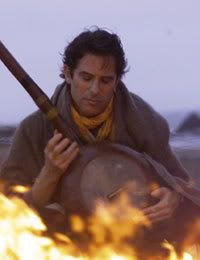
Until a few days ago if someone told me there was this singer called Jai Uttal, I would have shrugged it off. But today I am enchanted by this american man whose voice has enthralled me during the past few days.
I have listened to many of these american singers and preachers who have devoted most of their lives singing Hindu hymns and chants and have made a name for themselves in this special branch of hindustani classical music popularly known as bhajan, kirtan (or keertan) or chant as it is popularly known worldwide.
Krishna Das (not to be confused with Krishna Prema Das) is a well known name. Others are Bhagavan Das and Ram Dass to name a few. Some female voices are also known in India like Deva Premal and Jaya Lakshmi. Most of them are americans by birth (one of them is Irish as far as I remember) and all of them have made singing and teaching Hindu practices and Yoga as their profession. Most of them are also composing and singing 'Yoga Music' (as they call it) with the recent spurt in the popularity of Yoga worldwide notwithstanding.
But Jai Uttal is a little different from the other singers I have mentioned. He is Indian to the soul. Whereas other singers still retain their 'foreign' (or american) accent in their singing and inadvertently sound similar to ISKCON chanters, Jai Uttal sounds perfectly Indian. In fact due to his Indian sounding name and total sub continent accent I mistook him to be an Indian. Moreover his is a 'classically-trained-sounding' voice.
Incidently all the above mentioned male singers including Jai Uttal are known to be the disciples of Neem Karoli Baba, a revered saintly figure belonging to Akbarpur, Firozabad a town near Agra in India.
Jai Uttal has played Motown songs in cover bands and busked for change on the streets. Both of those experiences have stood him in good stead for his musical career, which finds his music straddling the divide between world and new age.
Born in New York City in 1952, Uttal grew up in the music business - his father worked for a record label - and at the age of seven he began piano lessons. Those were followed by banjo, guitar, and harmonica as Uttal began to discover American roots music, most especially the old-time banjo picking of Appalachian musician Roscoe Holcomb.
But his true spiritual epiphany came when he was 17 and first heard Indian music, which "touched my heart like sounds of my home," he said. "Then I got all the Indian albums I could, and jammed along on guitar with Ravi Shankar records."
His obsession became so great that at the age of 19 he headed for the West Coast, to study sarod and voice with the legendary Ali Akbar Khan. Eighteen months after that he traveled even further - to India itself, to experience the music and the culture first-hand. Renting a house in the Bengal city of Bhopur for $15 a month, he came to know singing street musicians the Bauls of Bengal, and started playing and traveling with them.
On his return to the U.S., he became more diligent in his study of Indian music, while supporting himself by playing guitar in bands whose material ranged from Motown covers to punk to blues.
His break came in 1991 when Triloka released his debut, Footprints, which included an appearance by jazz and world music innovator Don Cherry. With his band, the Pagan Love Orchestra, Uttal continued to mine spiritual, Indian-inflected music two years later on Monkey, which hit the Top Ten on the world music charts. Uttal also found himself producing his mentor, Ali Akbar Khan, for two records, Journey and Garden of Dreams, which found the maestro working with a Western orchestra for the first time. Uttal's next release, 1994's Beggars and Saints was his tribute to the Bauls of Bengal, in thanks for his formative time in Bhopur.
Three years later came Shiva Station, which was mixed by innovative producer Bill Laswell. After that he concentrated on touring with his band rather than recording. A compilation of his four Triloka albums appeared as Spirit Room in July 2000, shortly before the self-released Live Kirtan and Pagan Remixes, which, along with remixes of three Pagan Love Orchestra tracks, was comprised of chanting by Uttal recorded live in a yoga studio. It was followed by another remix EP, Guru Brahma/Malkouns, which included two cuts mixed by Asian Underground star Talvin Singh.
Courtesy : Chris Nickson
Listen to Jai Uttal singing Guru Brahma in his ever enchanting voice :
I also urge you to listen to this captivating song Bajrangi which he has rendered in Raga Durga (please correct me if I am wrong) :
Find more music of Jai Uttal in my new music folder at eSnips : Indian.Raga.New.Age.
I came to know Kabir Altaf accidently. I was searching for the present state of hindustani classical music in Pakistan on the internet and I found a few sound clips. When I first heard Kabir sing a Meera bhajan Badal Dekh Daree, I imagined him to be an old and seasoned singer of the past era. But how wrong I was.
A few days after I uploaded these sound clips on my Hindustani.Classical.Music folder at eSnips, I received a message from Kabir himself telling me how happy he was to find those clips on the internet. He is a mere 21 years of age and a student in the U.S. and he is still learning classical music. I was quite taken aback at knowing about his young age and such maturity in his voice. Only one other singer I know, has such a voice quality at an young age, who also had surprised me earlier. That is Moumita Mitra about whom I have written earlier.
Kabir Altaf was born in Karachi, Pakistan on February 3, 1986. At the age of 6, he moved with his family to the United States, where he grew up. Kabir has been learning Hindustani Classical Vocal from Ustad Hamid Hossain (based in Baltimore, Maryland) ever since he was ten years old. He has won several prizes at the Annual Indian Music and Dance Competition hosted by the Academy of Indian Music and Fine Arts and the University of Maryland-Baltimore County.
Kabir is currently a student at The George Washington University in Washington DC, where he is majoring in Music (Western Classical Vocal) and Dramatic Literature. He hopes to have a career that revolves around the performing arts, either as a professional musician or in arts-management.
Listen to this Meera Bhajan by him which he has sung with the maturity of a seasoned artist :
I am fortunate enough to have collected a large number of hindustani classical music songs over a period of couple of years. I have uploaded some in my eSnips folder :
I am no expert of classical music nor do I understand the intricacies and technicalities of such music but still I am fascinated by it. My eSnips folder is a tribute to all those young artists who have chosen to sing this genre of music inspite of better financial and glamourous lure of playback singing in the film world. Only an absolute dedication and love for their art has prevented them from swaying to the 'other' side.
I have included about 150 artists, some of them are very young and relatively less known but in no way less talented. I am also very happy to tell you all, that this eSnips folder has attained Google Page Ranking of 3 within two months. This blog too has a 2 ranking and my other blog Indian Raga at Wordpress has a Google Ranking of 4. Both these were created about the same time as my eSnips folder. This just proves that hindustani classical music is becoming more popular than ever before.
Hindustani Classical Music artists included in my eSnips folders are :
Adnan Sami (Piano)
Ajay Pohankar
Ajoy Chakrabarty
Ali Akbar Khan
Amelia Cuni
Amjad Ali Khan
Anita Sen
Anoushka Shankar
Anup Jalota
Anuradha Kuber
Arati Ankalikar
Ashiq Ali Khan
Ashwini Bhide
Bade Ghulam Ali Khan
Badar-uz-Zaman
Barkat Ali Khan
Begum Akhtar
Bhimsen Joshi
Bismillah Khan
C R Vyas
Chandrakantha
Channulal Mishra
Chitra Singh
D V Paluskar
Devki Pandit
Dilraj Kaur
Dilshad Khan
Dinkar Kaikini
Farida Khanum
Fateh Ali Khan (Patiala Gharana)
Firoz Dastur
Ganpati Bhat
Gauhar Jan
Ghulam Ali
Ghulam Hassan Shagan
Ghulam Mustafa Khan
Girija Devi
Hariprasad Chaurasia
Iqbal Bano
ITC-SRA Scholars
Jagdish Prasad
Jagjit Singh
Jai Uttal
Jayanti Sahasrabuddhe
Jitendra Abhisheki
Kabir Altaf
Kalapini Komkali
Kalpana Zokarkar
Kaushiki Chakrabarty
Khansahib Nasiruddin Saami
Kishori Amonkar
Kumar Gandharva
L Shankar (Violin)
Lakshmi Shankar
Latafat Hussain Khan
M S Subbulakshmi
Malini Rajurkar
Malavika Kanan
Mallikarjun Mansur
Mehdi Hassan
Mitali Banerjee Bhawmik
Mohammad Bakhsh
Moinuddin & Aminuddin Dagar
Moumita Mitra
Mubarak Ali Khan
Munawar Ali Khan
Nazakat & Salamat Ali Khan
Nirmalya Dey
Pandit Jasraj
Parween Sultana
Prabha Atre
Rajan & Sajan Mishra
Rashid Khan
Ratna Basu
Ravi Shankar
Rita Ganguly
Saleem Khan
Sanjeev Abhyankar
Satyasheel Deshpande
Sawani Shende
Shivkumar Sharma
Shobha Gurtu
Shruti Sadolikar
Shubha Mudgal
Shujaat Khan
Sipra Bose
Subha Joshi
Subhra Guha
Sultan Khan (Sarangi)
Taufiq Qureshi
Trilok Gurtu
Uday Bhawalkar
Ulhas Kashalkar
Vaishali K S
Vasundhara Komkali
Veena Sahasrabuddhe
Vishwa Mohan Bhatt
Zahida Parveen
Zakir Hussain
Zarina Begum
Zila Khan
... and many more.
More artists will be added soon. While visiting my classical music folder at eSnips don't forget to have a peek into my other music folders which have some interesting music of different genres. All the music is raga based.
When you think of Carnatic music, you think of temples, music which has retained its pristine purity over the ages and something strongly South Indian. But Carnatic music like all Indian art forms has been open to various cultural influences from all over the country and across the seas. Strange as it may sound, the British Raj and its bands have left a firm imprint on this most traditional music form. Muthuswami Dikshitar and Thyagaraja, two of the most revered composers of Carnatic music, were certainly influenced by the strange tunes from the British.
Perhaps the earliest innovation was the violin. This very Western instrument became part of the Carnatic music tradition when the family of composer Ramaswami Dikshitar moved from Tiruvarur to Madras in the 1790s. The five-year stay exposed brothers Muthuswami and Baluswami Dikshitars to the ‘airs’ that were being played by the Fort St George orchestra.
Baluswami Dikshitar learnt to play the violin from an Englishman and introduced it to the Carnatic concert platform. Muthuswami Dikshitar composed around fifty verses in Sanskrit, based on the orchestra’s music. The most famous among these is ‘Santatam Pahi Mam Sangita Shyamale’ which is set to the same tune as ‘God Save The King’! Muthuswami Dikshitar’s contemporary, Thyagaraja, composed ‘Raminsuvar Evarura’ in the Raga Suposhini, which was clearly inspired by music that accompanies march pasts.
His ‘Vara Lila Gana Lola’ in Raga Sankarabharanam, is also completely based on Western band tunes. Thyagaraja used words that had come into Telugu from English in some of his compositions. The usage of the word Landaru (from Lantern) in the kriti ‘Emi Jesite Nemi’ (Raga Todi) and Shalu (from Shawl) in the kriti ‘Jutamurare’ (Raga Arabhi) are examples.
The British were not immune to the beauty of Carnatic music. We have instances of singers such as Maha Vaidyanatha Sivan being appreciated by British officials. The antics and contortions of Sivagangai Periya Vaithi, are said to have scared at least one British Mem into hysterics.
Gopalakrishna Bharat’s Nandan Charitram moved a French official of Karaikkal to such an extent that he funded the first publication of the work. The Madras Jubilee Gayan Samaj opened its office in 1883 and among its patrons were such senior officials as Sir Charles Turner, Col McLeod and Gen S Chamier.
Programmes featuring Carnatic music were held at the Pachiappa’s Hall in George Town, Madras and many Englishmen attended these events. Patnam Subramanya Iyer, the composer who lived in Madras for 12 years, thereby acquiring the prefix Patnam (city), created the Raga Kathanakutoohalam, which can easily pass off as a melody in Western Music. His song ‘Raghuvamsa Sudha’ in this Raga is a favourite among instrumentalists, specially when they are performing to an International audience.
At the turn of the century, the Harikatha movement (story telling with music) was at its peak. Innovations were happening in this genre. Exponents such as Harikesanallur L Muthiah Bhagavatar and Tirupazhanam Panchapakesa Sastriar were in the fore front. A popular item in their repertoire was the description of Rama’s marriage to Sita. During their discourse they let their imagination run riot and even described a ‘band’ that belted out music during the wedding procession. The ever popular ‘English Note’ was created for this.
The Imperial Durbar of 1911 marked the zenith of the British Raj. The visit certainly influenced classical music. Gauhar Jan of Calcutta and Janki Bai of Allahabad performed a mujra for King George V, and for their song ‘Yeh Hai Tajposhi Ka Jalsa Mubarak Ho Mubarak Ho’ they were given a gift of 100 guineas. M Lakshmana Suri of Madras, father of Judge and musicologist T L Venkatarama Iyer and uncle to Harikesanallur L Muthaiah Bhagavatar, composed a set of 100 verses in Sanskrit on the King. It was titled ‘George Deva Shatakam’. He was awarded the title of Mahamahopadhyaya for the effort.
The Muthialpet Sabha of George Town, Madras, announced a competition among composers for coming up with a song on King George. The eminent vocalist and composer Ramanathapuram 'Poochi' Srinivasa Iyengar was awarded the gold medal for his kriti ‘Satatamu Brovumayya Chakravartini’ in Raga Todi. A mangalam (benediction) too was composed. It goes ‘Jayatu Jayatu Sarvabhauma George Nama, Sundari Mary Ragni Sahita Vijayi Bhava’.
It must have been very pleasant for Queen Mary to be called a beauty. Sadly the composer is not known. In the mid-thirties, Chittoor V Nagaiah released a 78 rpm recording of a Javali, that began with the words ‘O my lovely Lalana’. The song is a delightful mix of Telugu and English. Much closer to Independence, Ariyakkudi Ramanuja Iyengar had the occasion to perform before an English collector. In order to impress him, Iyengar began with the English note. The man was not happy. ‘‘When will you sing ‘Entaro Mahanubhavulu’?’’ he asked. Carnatic music had come full circle.
The influence has not vanished with the end of the British Raj. During the Rishabha Vahanam procession at the Kapaleeswarar temple in Mylapore, it is customary for the bearers of the idol to dance to the tune of a band during the last lap of the event. The tunes played are the English note and... hold your breath, ‘For He’s a Jolly Good Fellow’! But then that is quite a good description of the Lord.
Listen to this song by Zohra Bai Agrewali that reminds us of that lost era of Kings and Maharajas and their courtesans :
November 14,1902 : A very rudimentary and makeshift recording studio had been set up in two large rooms of a hotel in Calcutta by the Gramophone Company. Frederick William Gaisberg and his assistants had arrived just three weeks before from England on their first Far East recording expedition for the Gramophone Company, which had been founded in England in 1898. They had appointed a local agent for selecting and training artists for recording on gramophone discs. However, the agent selected Anglo-Indian artists and completely ignored local talent. Gaisberg then sought the help of the local Police Superintendent, visited several theaters, attended mehfils at wealthy Jamindars’ palaces, and thus found at least one promising artist to begin with. The artist was a very famous dancing girl, and her voice was very sweet, although not for European ears. She agreed to a recording session for the handsome fee of 3,000 rupees. Such an artist was necessary in order to build a firm business foundation on the Indian scene, especially when several other German, French and American recording companies were also planning to capture the Asian market in general and the Indian market in particular.
At around 9.00 a.m. a young lady entered the studio with all her paraphernalia, including accompanists and relatives. Loaded fully with very expensive ornaments and jewelry, this 30 year old, fair, medium-built lady went onto the stage prepared for the recordings. Sarangi, harmonium, and tabla players began to tune their instruments. Gaisberg personally checked the equipment. A thick wax master record was placed on the turntable rotating at 78 rpm. A huge recording horn was fitted on the wall behind her and close to her face, and she was asked to sing loudly into the horn. At the narrow end of the long horn a diaphragm fitted with a needle was connected to the recording machinery, with a needle placed on rotating disc for cutting the grooves. Gaisberg requested her to sing for three minutes and announce her name at the end of the recording. At the end of the trial recording she announced - 'My name is Gauhar Jan'. This announcement was necessary since the wax masters were sent to Hanover in Germany for pressing the records and the technicians would make proper labels and confirm the name by listening to these announcements at the end of the three minutes performance.
Although sound recording was invented by Thomas Alva Edison in 1877, it took 20 years for the technology to mature, and after 25 years, in 1902, the first ever recording of Indian classical music was engraved in the grooves of a gramophone record. The song can be played even today in 2007 on a shellac record and Gauhar Jan will sing it faithfully for the music lovers and listeners as long as the technology to play back that singing exists. Who was this Gauhar Jan - the first dancing girl of Calcutta ?
Born to Anglo-Indian parents, her name was Miss Angelina Yeoward. Her father, William Robert Yeoward, was an Armenian Jew working as an engineer in a factory producing dry ice at Azamgadh near Benares. He married a Jewish lady, Miss Victoria Hemming, around 1870, who was born and brought up in India and had learnt Indian dance and music. Angelina was born in 1873 and was baptized in the Methodist church in Azamgadh. This marriage did not last long due to Victoria’s love for dance and music and her relations with a Muslim friend named Khurshed. So after the divorce, she moved to Benares with Angelina and Khurshed, adopted Islam as her religion, and daughter and mother chose new names, Gauhar and Malka respectively. In those days, Benares was not only a sacred place, but also a seat of learning, a centre for all the performing arts, including dance, drama and music. She spent eight years learning the art to perfection and emerged as a well-trained Baiji, as she had decided to take up the profession of entertainer through dance and music. She became popular as Badi Malka Jan, badi (elder) because at that time three other Malka Jans were famous (viz. Malka Jan of Agra, Malka Jan of Mulk Pukhraj and Malka Jan of Chulbuli) and she was the eldest among them.
Around 1883, the trio moved to Calcutta, a place of great patronage for music and the other arts. In those days, both Hindu and Muslims Baijis from Benares, Agra and Lucknow used to settle in the Bow Bazaar area. The place was famous for courtesans or Kothewalis who would entertain wealthy Jamindars and Babus with their art. Some Ustads would train this community after a proper gandabandhan. Nawab Wajid Ali Shah had settled at Matiaburj near Calcutta in his last days and his court was full of musicians and artists. In such an atmosphere Badi Malka Jan soon established herself, and within three years she purchased a building at 24 Chitpore Road for Rs. 40,000. Little Gauhar, too, was fond of dance and music and took her initial lessons from her mother. She had a sharp memory, intelligence and learned very quickly, and so Malka appointed special teachers for teaching Gauhar languages, literature, and of course, dance and music. Kale Khan of Patiala, alias ‘Kalu Ustad’, and Ustad Vazir Khan of Rampur trained her in pure and light classical Hindustani vocal music, whereas Ali Baksh and Brindadin Maharaj taught her the Kathak form of dance. Srijanbai taught her dhrupad dhamar, and Charan Das trained her in Bengali Keertan. She also learnt from her contemporaries, viz. Mojuddin Khan, Bhaiyya Ganpatrao and Peara Saheb. She sang Tagore songs even before the word Rabindra-Sangeet had been coined. She penned several compositions under the name ‘Hamdam’, and she also wrote, composed and recorded ghazals. She could read, write and sing in several languages including Bengali, Hindustani, Gujrati, Tamil, Marathi, Arabic, Persian, Pushto, French, Peshawari and English.
After such intensive training, she first performed at Darbhanga State at the age of fifteen, and from 1896 she began to perform in Calcutta. She used to sing and dance at the houses of rich jamindars and her remuneration was in thousands of rupees. She was in great demand and even ordinary citizens wanted to listen to her music. Gaisberg noticed this and made her music available to listeners through her gramophone records. Gauhar Jan recorded prolifically, a total of over 600 songs over the period from 1902 to 1920, and she sang in more than ten languages. From 1903, her records began to appear on the Indian market, and were always in great demand. Thousands of copies were imported after being pressed at Hanover, and they were best-sellers throughout India. In 1908, a record-pressing factory was built at Sealdah (close to the present Sealdah railway station), Gaisberg was invited for this occasion and recorded a few more songs of Gauhar Jan, for which the announcement of her name at the end was not required.
The early records of Gauhar Jan are labeled ‘First dancing girl, Calcutta’. The word ‘first’ indicates her elevated position as the premier vocalist in the Calcutta's musical world of 1890-1910. She cut records of raagdari sangeet, thumri, dadra, kajri, chaiti, bhajan, tarana and she popularized various types of ‘Kachha’ gana through her records. This was remarkable when several great stalwarts of Indian classical music ignored the gramophone and recording medium completely and refused to record. She mastered the technique of presenting a musical item in just three minutes, and this became a model for the vocalists of the future. She recorded the music taught by her Ustads, which meant that she helped preserve our musical tradition of at least the three-four generations preceding her own. Thus her recordings are very useful for students and also for researchers who might wish to trace the development of Indian classical music over the last two or three hundred years. One of her records was cut in 1907, performed at the Town Hall in Bombay, as mentioned on the record label.
Through the wide circulation of her records, she became popular throughout India and received invitations in several prestigious music conferences. Thus in 1911, she was invited to participate in the Prayag Sangeet Samiti, for which she was paid 1000 rupees. Later, the same year, during the coronation of King George V at the Delhi Darbar, she was invited to sing a duet with Jankibai of Allahabad. They sang a Mujra song - Ye Hai Tajposhi Ka Jalsa, Mubarak Ho Mubarak Ho and received 100 guineas each as a gift from the King.
Gauhar Jan used to travel all over India, as a guest of patrons in the various Princely states. She also gave public performances, in which she would present ticketed programs, distributing an advance schedule of the items to be sung in her concert. She was fond of horse-racing and hence would visit Bombay during the racing season. She used to stay with Anjanibai Malpekar, spending the day at the Mahalakshmi racecourse, and the evenings and nights at concerts. She was a great admirer of Heerabai and offered to adopt her when Abdul Karim Khan’s family separated and the mother moved to Pune with her five children. She taught a number of bhajans and thumris to both Heerabai and Sunderabai, which they in their turn duly recorded on gramophone records. Because of Gauhar Jan the songs Radhe Krishna Bol Mukhase and Kridhna Murari Binat Karat became popular bhajans and several singers used to sing them in concerts and on records.
Gauhar Jan lived a very wealthy life, and she also donated generously to a number of causes. Numerous legends are associated with her. In Calcutta, she used to ride in a baggi driven by four horses, threw a party spending 20,000 rupees when her cat produced a litter of kittens, and donated only half the promised amount to Gandhiji’s ‘Swaraj fund’ when he did not keep the promise of attending the ‘fund raising’ concert and deputed a representative instead. In her personal life, she was deceived by her friends and relatives. She married her personal secretary - Saiyyad Gulam Abbas - a young man from Peshawar. He was ten years younger than her, and when she discovered his relations with other women, she was bitterly disappointed in him, and this led to several court cases and unpleasant incidents. Later, she stayed with Amrut Vagal Nayak in Bombay - a handsome actor on the Gujrati stage. This relation lasted for 3-4 years, and she learnt several songs composed by him including the famous Dadra, Aan Ban Jiyamen Lagi. The sudden death of Amrut Nayak was a big jolt that left her mentally disturbed. Relatives persuaded her to return to Calcutta. But she did not stay there long. The machinations of selfish and cunning relatives forced her to stay in Darbhanga State for a while. Finally she joined the service of the Mysore State, where she died in 1930.
She has left over 150 records and most of them are in the safe custody of record collectors. The Gramophone company reissued 18 songs in 1994 on audio tape and CD under the banner of ‘Chairman’s Choice’, which no one (except perhaps the Chairman) noticed, due to lack of adequate publicity. It is necessary to preserve the legacy of Gauhar Jan in a more full-scale way for posterity, and some die-hard collectors and music lovers have committed themselves to accomplishing this task.
Here is one of those early recordings...listen to her announcing her name in the end..."My name is Gauhar Jan" :