Continuing with my Random Songs series, presented here in this post are a few songs that I picked up from here and there while surfing the web, and also while hanging out on various music forums. These are excellent songs, a couple of them from the great maestros and the rest from our younger vocalists.
Mallikarjun Mansur - Sughrai - Piya Banjara :
Ajoy Chakrabarty - Deshkar - Ayi Ri Badariya Sawan Ki :
Manjiri Asanare - Adana - Rang Rang Mukh Pe Mat Phenko :
Meeta Pandit - Bilaskhani Todi - Baje Boondariya :
The Jaipur Gharana (also known as the Jaipur-AtrauliGharana) is a Khayal based Gharana, founded by Ustad Alladiya Khan (1855-1946) in the late 19th century. An offshoot of the Agra Gharana, the Jaipur Gharana acquired its name and status as a Gharana in the early half of the 20th century as a result of the growing popularity of stalwarts of this Gharana like Kesarbai Kerkar, Mogubai Kurdikar, Mallikarjun Mansur and Kishori Amonkar.
The Gharana is unique in that it was the first Gharana to be founded in Khayal Gayaki, whereas other major Gharanas were initially founded as Dhrupad-Dhamar Gayakis and eventually evolved into the Khayal Gayaki. The founder of this Gharana, Ustad Alladiya Khan initially developed the unique Gayaki of this Gharana following the partial loss of his voice which prompted him to develop an adjusted singing style to accommodate this handicap. As a result of his exploration, he raised the level of musical and vocal artistry to such heights that he was acclaimed as the 'High Priest of Khayal Gayaki'.
Mallikarjun Mansur - Deshkar - Hu To Tore Karan Jagi :
Kishori Amonkar - Bhairavi - Koyaliya Na Bolo Dar :
Ulhas Kashalkar - Lalit Pancham - Udat Boondan :
Shruti Sadolikar - Bhairavi - Bajuband Khul Khul Jai :
Renowned names of Jaipur Gharana include Jitendra Abhisheki, Padmavati Shaligram, Manik Bhide, Ashwini Bhide Deshpande, Manjiri Asanare and many more, besides the artists mentioned at the beginning of this post. As is usual with most Gharanas, the list is long.
Once again I am posting a few songs of my choice. All the artists featured this time are very well known to real connoisseurs of classical music, hence I am skipping the introduction bit.
Mallikarjun Mansur - Basanti Kedar - Atar Sugandh Gulab :
Kumar Gandharva - Shuddh Shyam - Moye Bula Ke Poochho Na :
Another installment of songs that I picked up from here and there, while surfing the web. For the first time, I am not giving you the download links due to bandwidth restriction on the respective servers. You may however, fish out these files from the Internet Explorer Cache after playing them to their full length :
Rashid Khan - Raga Jogkauns - Peer Parayi Jane Nahi : (Download)
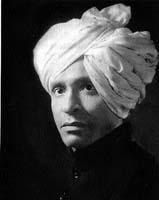
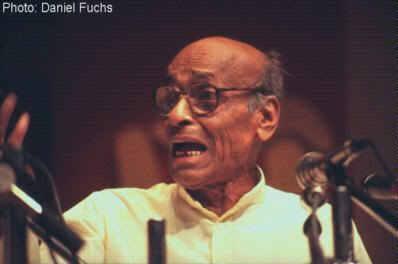
He did not clothe himself in princely robes. He did not care to be the center of attraction. He was content to be inconspicuous. He continued to look like a shopkeeper's accountant. He did not speak like an oracle. He rarely referred to his triumphs. He won not only the respect but the affection of his contemporaries. He was wholly without envy. His airs were what he sang. He did not put on any. That was Pandit Mallikarjun Mansur for you.
Three crisp songs from the maestro of the Jaipur AtrauliGharana :
Mallikarjun Mansur was born on December 31, 1910 in a village in Dharwad district of Karnataka. He had four brothers and three sisters. His elder brother Baswaraj had his own theatre troupe. At the age of nine, Mallikarjun played a small part in a play. The experience fascinated him so much that he ran away from home and joined a touring drama troupe. Although his father brought him back home, the stage continued to fascinate him and he soon joined another touring theatrical company.
It was through the initiative of a friend that Ustad Manji Khan of the JaipurGharana, noticed Mallikarjun. Already trained in the Gwalior style, Mallikarjun was able to absorb the rich Jaipur style. The virtuosity of the Jaipur Gharana was more evident in his style. He could cast a hypnotic spell on his audience with his astounding breath control and the absolute purity of his swaras. There was always a special intensity to his singing, a special urgency and earnestness in his treatment of melody.
The most memorable among his early concerts was the Ganesha Utsav concert in Mumbai, in which he sang for over six hours. In 1932, after a special audition by HMV, he cut his first gramophone record. But although he had made several discs for HMV when he was still in his early twenties, music did not become a paying profession to Mallikarjun until much later in life.
Mallikarjun had always led a simple life. So many of our well known artists move about with a swagger for they seem to believe that they are indeed the colossi striding the scene. Mallikarjun did not possess a regal bearing. He did not clothe himself in princely robes. He did not care to be the center of attraction. He continued to look like a shopkeeper's accountant. He rarely referred to his triumphs. He won not only the respect but the affection of his contemporaries. He was wholly without envy. His airs were what he sang. He did not put on any.
Struck by lung cancer, he died on Saturday September 12, 1992.


 raga bhimpalasi


