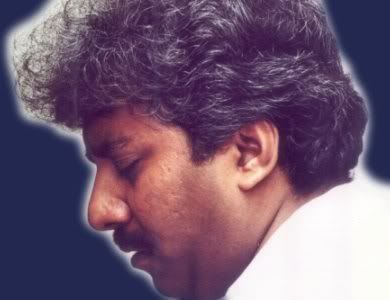
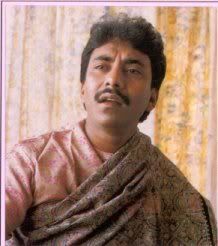
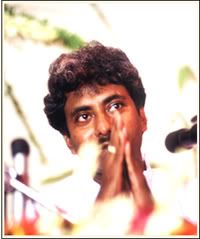
Rampur-Sahaswan is a gharana of Hindustani classical music centred in the Uttar Pradesh towns of Rampur and Sahaswan. The history of this gharana begins with Inayat Hussain Khan (1849-1919). He was the son of Mehboob Khan, a khayal singer and Veena player of the Rampur court. Mehboob Khan is said to have performed khayals in a simple style with an emphasis on tappa style taans, which can be taken to be an indication of his affiliation to the Gwalior khayal gharana. He was also a beenkar and veena player. Inayat Hussain Khan had a cousin, Haider Khan, whose grandson was Nissar Hussain Khan (1906-1993). Inayat Hussain Khan is said to have shown unusual singing talent in his childhood and so his father took him to the chief court musician of the Rampur court for further training.
So as Inayat Hussain Khan, the founder of the gharana, hailed from Sahaswan and was trained and lived in Rampur, the gharana came to be called Rampur-Sahaswan. Inayat Hussain trained his son Sabir Hussain and his son-in-law Mushtaq Hussain Khan (1874-1964). It is through the styles of his sons-in-law that contemporary experts have formed their idea of the Rampur-Sahaswan style and it is through his sons-in-law that the gharana stays aloft today. Like the sons-in-law, Inayat Hussain's three daughters, naturally played a big role in keeping the gharana alive. The youngest daughter Sabri Begum gave birth to leading senior contemporary exponent Ghulam Mustafa Khan and daughter Shakhri Begum. Shakhri Begum gave birth to Rashid Khan, the famous vocalist.
Mushtaq Hussain Khan - Meera Bai Ki Malhar :
Nissar Hussain Khan - Puriya Dhanashree :
Ghulam Mustafa Khan - Pilu - Ghir Ke Aayi Badaria :
Rashid Khan - Alahiya Bilawal - Sumiran Kar Man :
The renowned singers of this gharana include Mushtaq Hussain Khan, Nissar Hussain Khan, Ghulam Mustafa Khan, Ghulam Sadiq Khan, Rashid Khan, Ghulam Abbas Khan, Begum Shanno Khurana and Sulochana Brahaspati.
Rashid Khan had truly arrived on the classical music scene when Pandit Bhimsen Joshi heard him at a concert in early 1988. "There is now at least one person in sight who is an assurance for the future of Indian vocal music", said Pandit Bhimsen Joshi, voicing the concern of connoisseurs of Hindustani vocal music about whether its tradition of excellence would continue.
Rashid Khan, blessed with a deep rich and powerful voice is often hailed as the greatest vocalist alive. His uncanny ability to capture the essence of a raga is unmatched. His taans are so virtuous that one must hear them to believe them.
Being an ardent fan of Rashid Khan, maestro of the Rampur-Sahaswan Gharana, I can't resist putting more songs of him on this blog. He is one of the best among the contemporary vocalists and his effortless singing and silk like voice just keeps me spellbound.
Gorakh Kalyan - Tum Bin - Kab Ghar Aayo : (Download)
Kiravani - Brij Ke Nandlala Tore Bina Mohe Chain : (Download)
Malkauns - Tu Hai Malik Mero - Yaad Aavat Mohe : (Download)
Endowed with an exceptionally melodious and sensitively adaptable voice, Ghulam Mustafa Khan's music gives witness to the rigorous traditional training that he received from his distinguished gurus. He hails from a family steeped in North Indian Classical vocal music culture, his forefathers being some of the most prized court musicians honoured and celebrated by the Kings and Maharajas in a musical lineage that goes back to more than 150 years.
Ghulam Mustafa Khan has brought these traditions into the present with great effect, and added his own personal traits. Born over seven decades ago, on March 3, 1931, in the Badayun city of Uttar Pradesh, Ghulam Mustafa Khan was initiated into music by his father, Ustad Waris Hussain Khan. Later he was groomed under Ustad Fida Hussain Khan, and then later his son Nissar Hussain Khan.
Ghulam Mustafa Khan belongs to an illustrious school of music known as 'Sahaswan Rampur Gharana'. This Gharana has produced an abundance of khayal singers since the time of its founder Ustad Inayat Hussain Khan (1849-1919).
Khayal, in Urdu meaning imagination, is the most popular genre of North Indian classical vocal music, designed to give the singer optimum scope for improvisation. Originating in the courts of the Moghul emperors as a less rigid alternative to the Dhrupad style, it has evolved into a remarkably flexible form that allows an artist's individuality considerable rein. Even within the past five decades the form has undergone many changes, and the tradition of innovation continues through pioneers like Ghulam Mustafa Khan.
Khayal has several schools following different style traditions. Most of these Gharanas have been built around certain families or specific locations like Gwalior and Rampur. Gharanas traditionally followed the Guru-Shishya system of instruction in which direct, one-on-one teaching and personal supervision meant a clearer and therefore deeper understanding, of both the traditions of that Gharana, of the raga, and of the role of a particular style in exploring and presenting that raga. As Inayat Hussain, the founder of the gharana, hailed from Sahaswan and was trained and lived in Rampur, this gharana came to be called Rampur Sahaswan.
It's always been a struggle for khayal singers to establish themselves on the world music scene, because of the barrier of language. In fact, the lyrical content of the khayal while certainly enhancing the beauty of the presentation is regarded as secondary to the ability of the performer to improvise within the framework of the specific raga. The emphasis on lyrical content varies from artist to artist, many of the texts of khayal are written in an ancient form of Hindi known as Brij Bhasha. Khayal has also had a profound influence on instrumental music. Many instrumentalists point out that Indian music IS vocal music, and that the instrument should sing in the style of khayal.
Ghulam Mustafa Khan's contribution goes beyond his own performance. He has trained and moulded some of India's finest film singers including Manna Dey, Sonu Nigam and Hariharan. He was awarded the Padma Shree in 1991 by the Indian Government in recognition of his service to Indian music heritage.
Here I am presenting four songs from his album Sur Dhwani :
Rashid Khan, born in 1966, is perhaps the most convincing proof of what miracles the revived Gurukul system can achieve. Under the tutelage of Ustad Nissar Hussain Khan, the Sahaswan Gharana maestro, for the last ten years in Research Academy, Calcutta, Rashid has metamorphosed from a gawky, groaning child to an artiste of unbelievable maturity, vocal prowess and artistry.
Rashid's alap is ticklishly imaginitive, his rhythmic play pulsating and the cascades of his powerful, lightening, swift taans unimaginable until actually heard.
Rashid has naturally taken listeners and the Press by storm wherever he has gone, and at a conference at Bhubaneahwar in 1982, a member of audience was so overwhelmed by the uncanny expertise of the young boy that he promptly made him a gift of one thousand Rupees.
In 1986 the Festival of India authorities invited Rashid Khan to present the only music recital on the occasion of the release of Double Album on Great Masters of Music by the then Prime Minister of India, late Rajiv Gandhi. The concert was intended to signify the continuance of the tradition of excellence in Indian classical music.
Rashid Khan was awarded the 'A' Grade by All India Radio in 1987. In 1988 he cut his first record. Doordarshan has produced and telecast a special programme on this phenomenon. In 1989 Rashid Khan made an extensive tour of the United States and Canada, taking, as usual, crowds by storm.
Rashid Khan has been hailed as a great successor to the Bade Ghulam Ali Khan - Ameer Khan generation - an era today almost given up as lost. He had truly arrived on the scene when Pt. Bhimsen Joshi heard him at a concert in early 1988 and proclaimed that there is now at least one person in sight who is an assurance for the future of Hindustani Vocal Music.
Listen to this composition sung by him in Raga Jaijaivanti from his album 'Mercy Rain' :