Shankar Family & Friends (1974), Disc 3 of the Ravi Shankar George Harrison Collaborations box set (3CD/1DVD), is the first joint recording project between the two. Shankar Family & Friends brought together Indian classical music icons such as Alla Rakha, Hariprasad Chaurasia, Shivkumar Sharma, Lakshmi Shankar, L Subramanium and Western rock and jazz musicians, including Ringo Starr, Billy Preston, Jim Keltner, Tom Scott, Klaus Voormann and Hari Georgeson (George Harrison). Composed by Ravi Shankar and produced by George Harrison, one half of the album comprises instrumentals and songs, while the second half is a thematic ballet. The instrumental part, I'm afraid, doesn't live up to the expectation one would associate with such immortal geniuses. However, excellent vocals by the nightingale of Indian classical music, Lakshmi Shankar, are enough to lure you into preserving this CD for posterity.
Shankar Family & Friends - I Am Missing You (Indian Version) (30 sec) :
Music Festival From India DVD is the real cherry on the cake. It is a rare, previously unreleased concert performance recorded at London's Royal Albert Hall in 1974. This entire concert was originally filmed and recorded for the Material World Charitable Foundation. Over the years, many of these master films have been lost, destroyed or misplaced. This bonus DVD compiles all the complete filmed performances discovered from this historic concert, and the entire concert in stereo and 5.1 audio. The DVD includes the concert film and separate concert audio. The bonus feature (Ravi and Anoushka Mixing in 5.1) is rather disappointing though.
Some never-before released tracks on the DVD :
Music Festival (DVD) - Alap, Noom Toom, Jor in Raga Abhogi (30 sec) :
Music Festival (DVD) - Dhamar in Raga Vasanta (30 sec) :
Music Festival (DVD) - Khyal in Raga Kedara (30 sec) :
Music Festival (DVD) - Raga Mala based on Raga Khamaj (30 sec) :
Sanskrit chants from Vedas, Upanishads and other scriptures have been recorded by many in India and elsewhere, either in its original form by the traditional scholars who have kept it up for many centuries through their families and disciples, or sung within Raga forms by eminent musicians with accompanying instruments. Some have attempted to make them more popular by using semi-classical form of music. Chants Of India included in the Ravi Shankar George Harrison Collaborations box set (3CD/1DVD) are timeless Suktas, Mantras and Shlokas that are chanted as they were 4000 years ago.
Chants Of India, Disc 1 of the Collaborations box set, was an absolute bestseller when it was first released in 1997. The album sold 1,00,000 units in the US alone. The idea of creating music for ancient Sanskrit chants appealed to George Harrison so much that he wanted to take the whole responsibility of producing it. The music was recorded in two sessions, one in Madras (January and April 1996) and one at George's studio in England (July 1996). To maintain the integrity and purity of the ancient Vedic chants was a tremendous challenge to both George Harrison and Ravi Shankar.
Chants Of India - Vandanaa Trayee (30 sec) :
Chants Of India - Asato Maa (30 sec) :
Chants Of India - Gaayatri (30 sec) :
Chants Of India - Prabhujee (30 sec) :
"I always had in my mind not to make it so difficult for hearing, for people who are not used to our music at all, for instance. But apart from the words, which are very old and they all mean the same thing, peace and love, for equality for human beings, body, spirit, everything. Until about 30 years or 40 years ago, these chants were absolutely not heard. But now everything's out. It's even on the internet, you know." ~ Ravi Shankar
"It's such a beautiful record, it's something which I was proud to be able to contribute a little bit towards. It's something which I think has a value, and I think a lot of people can benefit by having this kind of music in their lives, help as a balance towards a peaceful daily life." ~ George Harrison
Chants Of India album had been out of license for over 5 years.
Music Festival From India, Disc 2 of the Collaborations box set, was a live event that was staged in London in 1976. Organized by George Harrison's Material World Charitable Foundation, the event witnessed an Indian classical ensemble of 18 artists. Musicians including tabla wizard Alla Rakha, santoor player Shivkumar Sharma, flautist Hariprasad Chaurasia, sarangi maestro Sultan Khan, vocalist Lakshmi Shankar, violinist L Subramaniam graced the occasion. This troupe then toured Europe culminating in a show at London's Royal Albert Hall. The event propelled most of the artists who participated to worldwide stardom.
Music Festival From India - Tarana, Chaturang (30 sec) :
Music Festival From India - Bhajan (Krishna Krishna) (30 sec) :
Music Festival From India - Naderdani (30 sec) :
Music Festival From India - Dehati (30 sec) :
Composed by Ravi Shankar and recorded during five weeks in 1976, this album was produced by George Harrison. Music Festival From India was only released on vinyl, and has not been available for over 30 years.
In 1965 when George Harrison strummed the sitar in The Beatles' number Norwegian Wood for their album Rubber Soul, nobody could have thought that in the coming days he was going to have the most beautiful, both personal and musical, friendship with the maestro of the instrument, Pandit Ravi Shankar. Earlier George was introduced to the sitar during the filming of the 1965 movie Help! in the Bahamas, where some Indian musicians were featured in a scene.
"I went and bought a sitar from a little shop in Oxford Street - it stocked little carvings, and incense. It was a real crummy-quality one, but I bought it and mucked about with it a bit. Anyway, we were at the point where we'd recorded the Norwegian Wood backing track and it needed something. We would usually start looking through the cupboard to see if we could come up with something, a new sound, and I picked the sitar up - it was just lying around, I hadn't really figured out what to do with it. It was quite spontaneous, I found the notes, it fitted and it worked." ~ George Harrison
George Harrison plays the sitar in Norwegian Wood (30 sec clip) 1965 :
George met Ravi Shankar through a friend from a society called Asian Music Circle. And what an encounter it was. Ravi Shankar, the older of the two, had a complete command of the Indian musical tradition, both ancient and ageless. The other younger man, George Harrison, was a founding member of the Beatles, without question, the most influential and universally loved creators of today’s popular music. It was inevitable that this match would make waves, which it did on a tremendous scale and for a passionate worldwide audience.
"In 1966, through the grace of God my life was blessed and enhanced from the sudden desire to investigate the classical music of India. Although intellectually, I could not comprehend it, the music (which happened to be Ravi Shankar and the sitar) made more sense to me than anything I had heard in my life. When I read Ravi saying he felt he had only started, I was overwhelmed, humbled and encouraged to try and understand the music and the man much more." ~ George Harrison
"The friendship with George started in 1966 and that's when I met him along with the other three, but George was something very special from the very beginning. Something clicked between us and he was so interested in wanting to know about Indian music." ~ Ravi Shankar
This is how the interesting, unique and lifelong friendship began between George Harrison and Ravi Shankar. In 1973, George Harrison signed Ravi Shankar to his Dark Horses Records label. In 1974, their first project, Shankar Family & Friends brought together renowned Indian classical musicians like Ustad Alla Rakha, Lakshmi Shankar, Shivkumar Sharma, Hariprasad Chaurasia alongside Western jazz and rock musicians including George himself, Ringo Starr, Tom Scott, Klaus Voormann, Jim Keltner and Billy Preston.
Ravi Shankar's Music Festival From India (live from the Royal Albert Hall) in 1976 was the first artistic event organized and sponsored by George Harrison, bringing together, perhaps for the first time outside India, a 17-piece Indian classical music ensemble.
In 1997 George Harrison and Ravi Shankar again collaborated on an album. This time Ravi Shankar created music for ancient Sanskrit chants with the challenge of maintaining the authencity of the ancient verses, along with the original compositions. Released in 1997, Chants Of India are timeless, Vedic verses chanted for the well being of man and mankind.
Collaborations is a celebration of these two musical geniuses and how their friendship and deep mutual respect for each other created opportunities to push musical boundaries. It includes all the above mentioned performances and more. Collaborations is a 3 CD/1 DVD limited edition box set. The DVD is a rare, previously unreleased live concert performance of Ravi Shankar's Music Festival From India. It also includes the rare and preserved parts of the concert film and a surprise bonus feature.
View an excellent video clip (Naderdani) from Music Festival From India at Amazon.com.
India has a rich source of instrumental music with its innumerable kinds of musical instruments be it classical, traditional or folk. The mild and melodious tunes of bansuri or the healing sound of sitar, each one soothes the mind and soul. Instrumental music can be used as the best kind of meditation music. The beautiful sounds of instruments help the mind and soul to relax and concentrate on a single thought.
Indian classical music is a part of the Indian heritage, and is said to be found in the oldest scriptures, namely the Vedas. Indian instrumental music is a part of the classical music and is a much revered tradition of India. Globally, Indian instrumental classical music has greater acceptance than classical vocal music. The reason attributed for this is that the lyrics in Indian vocal music are incomprehensible to people other than Indians. Presented here are four of the most delightful performances on various instruments.
Before entering into the new year it would be a great idea to listen to a few songs sung by some non conventional singers. All the artists featured here are great achievers of their chosen art form. Ustad Bundu Khan, was probably the most outstanding Sarangi player during the first half of the 20th century. After migrating to Pakistan during the partition in 1947, he continued to play the Sarangi till his death in 1955. His son, Umrao Bundu Khan has continued his musical tradition. Ustad Vilayat Khan and Pandit Ravi Shankar are considered to be the best Sitar players of all-time. Who was better between the two is a matter of undying debate. Pandit Birju Maharaj is the undisputed emperor of Kathak dance.
Some have heard of her. Few have met her. None truly know her. Sarod wizard Ustad Ali Akbar Khan said of her, she is 'simply great'. Pandit Ravi Shankar acknowledges her genius. Yet, none have heard her play. Mysterious, intriguing, she is like our own Greta Garbo, living in her own shadows, shutting herself out from the world in the cloistered confines of a city flat, seeking peace in an instrument her father taught her. She wants nothing from the world, from society. But if she decided to give of herself, the world would be a richer place.
Six floors up the elevator in a high-rise building, in one of the posh residential localities of Mumbai, lives this woman. No one sees her, not even her immediate neighbours. The board at the entrance of the building simply spells: Annapurna Devi. Another square board is nailed next to her doorbell. It reads :
1. The door will not be opened on Mondays and Fridays. 2. Please ring the bell only thrice. 3. If no one opens the door please leave your name and address. ~ Thank you very much. Inconvenience is regretted.
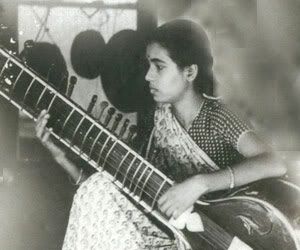
Annapurna Devi, who was born as Roshanara Khan in 1926 at Maihar in the state of Madhya Pradesh, India, is a maestro of Surbahar or the bass Sitar. Her father Ustad Allauddin Khan, who also happened to be her guru, was the founder of the famous Maihar Gharana or the Senia Maihar School and was regarded as one of the greatest instrumentalists of the 20th century. Sarod maestro Ustad Ali Akbar Khan was her brother and she married Pandit Ravi Shankar, also a pupil of Allauddin Khan, at a very early age. Annapurna Devi emerged as a proficient Surbahar maestro of the Maihar Gharana just within few years of taking music lessons.
Soon after she even started giving music lessons to some of the students of her father like Pandit Nikhil Banerjee and Ustad Bahadur Khan. Baba, as Allauddin Khan was called by his disciples, was a very strict man and his temper was well known. There were times when the boys were so petrified that they dared not approach Baba and the only person who had access to him was Annapurna. He taught her, and she in turn often taught the boys. The trio of Annapurna Devi, Ravi Shankar and Ali Akbar Khan, began a long and arduous journey, trying to plumb the depths of a 5000 year old tradition of Hindustani music.
Raga Kaushiki :
Raga Manj Khamaj :
Annapurna Devi's marriage to Ravi Shankar was arranged with the suggestion of Uday Shankar, his celebrated elder brother. Annapurna Devi, who was only 14, wedded Ravi Shankar when he was 21 years old. Though a tumultuous one, the marriage lasted for some 20 years during which the couple gave birth to a son, Shubhendra Shankar. It could have been a fairy tale or an eternal duet between two maestros, but somewhere at the height of the glory something happened and the relationship snapped like a thin thread.
There were whispers, as they were bound to be, given the fame of the two musicians and given the fact that they were husband and wife. Many say, Ravi Shankar fell in love with somebody else, a woman known as Kamala. Perhaps the affair became too big and Annapurna was definitely hurt by the entire thing. This and her father's subsequent death dealt a severe blow to her, something that she could never recover from. She became a recluse thereafter, totally cut off from the rest of the world.
During better times with Ravi Shankar :
Raga Yaman Kalyan (with Ravi Shankar on the Sitar) :
By all accounts, Annapurna Devi's only public concert was staged in the early 1950s, and no one has ever heard her play the Surbahar or Sitar in public or private ever since. Few have seen her, fewer still have heard her play. She has performed a total of 11 times in her life. Finding a recording of hers is like locating a needle in a haystack. Her students say that she imparts instructions through singing and not through playing her instrument, and she conducts her lessons only in the late hours of the night, more often after midnight. What is more, she has remained inaccessible and unapproachable even to her own students without prior consent and appointment. Neither does she make herself available on telephone, nor entertain any visitors. She is allergic to press reporters, critics and lensmen.
As a teacher, she has had many noteworthy students like Ustad Aashish Khan, renowned flautist Hariprasad Chaurasia and others. She has not recorded any music albums. But some of her performances, notably Raga Kausi Kanara, Raga Manj Khamaj and Raga Yaman with Ravi Shankar have been secretly taped from her earlier concerts, and are available but not commercially. In spite of her avoidance of media limelight, she continues to be thought of as a classical instrumentalist of the highest calibre in India. All the awards she has received, including the Padma Bhushan in 1977, Sangeet Natak Akademi Award in 1991 and the Desikottama Award (highest honour conferred by the Vishwa Bharati University, Shantiniketan) in 1999, have been accepted in absentia.
In the last 50-60 years, there has been an explosive influence of Indian music, specially instrumental, in the West. Most known, the wonders of the Indian music were spread by famous violinist Yehudi Menuhin in the 1950s and George Harrison of the Beatles in 1960s. The year 1967 saw the growing influence of Sitar maestro Pandit Ravi Shankar and Sarod maestro Ustad Ali Akbar Khan. Four years later, in 1971, George Harrison organized the ground breaking Concert for Bangladesh at Madison Square Garden in New York City, the first charity event of Rock, where an audience of 40,000 Westerners, new to the sounds they heard, applauded after the musicians had finished tuning their instruments. Ravi Shankar had then famously remarked, "Thank you, if you appreciate the tuning so much, I hope you will enjoy the playing more." Ravi Shankar had already wowed audiences at the Monterey Pop Festival, and he achieved stardom at the Madison Square Garden event.
Ravi Shankar & Ali Akbar Khan - Concert for Bangladesh : (Download)
Vilayat Khan - Raga Jhinjhoti (Sings as he plays the Sitar) : (Download)
Later in life, Ravi Shankar was named the 'Godfather of World Music' by George Harrison. In an interview Sarod maestro Ustad Amjad Ali Khan said of Pandit Ravi Shankar, "My greatest admiration for him stems from the fact that, here is a man who had no gharana to talk about. His father was not a musician, his guru’s father was not a musician. On top of that his guru was a sarod player. Look at the odds he beat to become the extraordinary musician he became." While Pandit Ravi Shankar was winning the hearts of the western audiences, Sitar maestro Ustad Vilayat Khan with his Gayaki-Ang style of Sitar playing, remained the darling of the home crowds.
This era also witnessed the emergence of Santoor as a mainstream classical instrument, thanks to Pandit Shivkumar Sharma, the slide Guitar taking form of Mohan Veena due to the efforts of Pandit Vishwa Mohan Bhatt, and the Tabla finally being accepted as a solo instrument due to the genius of Ustad Zakir Hussain. Indian classical instrumental music had finally arrived on the global stage. Globally, InstrumentalHindustani classical music was being accepted more than the Vocal music. The reason attributed for this is that the lyrics of vocal music are incomprehensible to people other than the Indians, hence cannot be appreciated in the true manner.
Ali Akbar Khan & John Handy - Karuna Supreme : (Download)
A lot of experimentation is being done in instrumental music these days. The latest instrument to enter the world of hindustani classical music is the Touchstyle Fretboard (otherwise called the Chapman Stick), a sort of a slide Guitar, where strings are tapped instead of being plucked. The artist is Teed Rockwell and his new album is Hindustani Ragas. JazzSaxophonist, John Handy is another instrumentalist who has played a lot with his Indian counterparts.