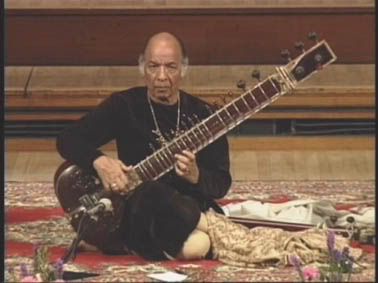
Indian classical instrumental is a much sought after genre of music all over the world today. Gone are the days when listeners from Western countries could not make out if the instrument that was being played was sarod or sitar. The only sound that convinced Westerners that the music is really Indian was the constant drone of the tanpura. But thereafter, of course, the sounds of the sitar strings became recognizable everywhere and even got featured in a few Hollywood movies of the 1950s and 1960s. The sound was also noticed by many Rock bands of the West and some experimented with it in their music.
Bismillah Khan - Malkauns (Shehnai) :
Hariprasad Chaurasia - Pilu (Bansuri) :
Ali Akbar Khan - Gour Sarang (Sarod) Vocals: Asha Bhonsle :
Anoushka Shankar - Shuddha Sarang (Sitar) :
Note: Please inter-change the names of the last two songs after you download them. They were wrongly named while uploading.
India has a rich source of instrumental music with its innumerable kinds of musical instruments be it classical, traditional or folk. The mild and melodious tunes of bansuri or the healing sound of sitar, each one soothes the mind and soul. Instrumental music can be used as the best kind of meditation music. The beautiful sounds of instruments help the mind and soul to relax and concentrate on a single thought.
Indian classical music is a part of the Indian heritage, and is said to be found in the oldest scriptures, namely the Vedas. Indian instrumental music is a part of the classical music and is a much revered tradition of India. Globally, Indian instrumental classical music has greater acceptance than classical vocal music. The reason attributed for this is that the lyrics in Indian vocal music are incomprehensible to people other than Indians. Presented here are four of the most delightful performances on various instruments.
Shujaat Khan, son of legendary sitarist Ustad Vilayat Khan, is easily one of the most recognized faces of Hindustani classical music all over the world. He has musical pedigree that goes back seven generations. He has developed a personal style further extending the gayaki ang (singing style) of sitar, his father had innovated. The gayaki ang is imitative of the subtleties of the human voice. Shujaat Khan continues another Vilayat Khan tradition by singing the lyrics of the khayal as he plays the sitar. It often doesn't seem as if he's singing to anyone but himself, each time returning to the sitar and echoing his vocals with equally emphatic interpretation on the instrument.
Shujaat Khan - Kamod - Jane Na Doongi :
Shujaat Khan - Manj Khamaj - Aeri Sakhi :
Shujaat Khan - Piloo - More Saiyanji Utrenge Paar :
My good friend from Lahore, Dr. Ashfaq A Khan akaholistic, who has uploaded one of the finest personal collections of classical music on eSnips, told me once, "Collectors are like snakes, coiled tight over a treasure chest. They will snap at you if you even, as much as, try to touch the chest. Leave alone taking a few jewels from it." Dr. Khan abhors music collectors. His gesture of sharing very rare recordings of private mehfils of great maestros proves a point. Unlike collectors of other curios like coins or stamps, a music collector has nothing to lose if he lets other people have copies of a few rare songs, especially in this age of digitized music. The original songs will stay intact without losing their quality even if one hundred people downloaded them. Strangely, a few collectors cannot bear the sight of someone who has, what the collector thinks was his sole right to possess. Contrary to what many people think, I am not a music collector in the conventional sense. I love it when people download songs from my blog. More the merrier.
Another friend, a regular visitor on this blog, Shri Virendra Nath Bali from Delhi was kind enough to send me a couple of recordings of Sitar recitals by his late father Pandit S N Bali, a renowned player of the 'tantkari' style Sitar. He wants me to share these with you all. The recitals were broadcast on the Allahabad / Benares Radio. Here are some memories, as recalled by his son. S N Bali was a disciple of Ustad Hamid Hussain Khan, a very ill-tempered and reserved man, who never wanted to part with certain closely guarded secrets of his khandani Sitar techniques to a non-family person. S N Bali used to stealthily climb the staircase of Khan Saheb's room and listen to his playing at his private riyaz time. One day as the Ustad was strolling in the campus of the Marris Music College, he froze to attention at a particular spot upon hearing the replica of his most confidential Taans and Gat on the Sitar. He immediately called the watchman and ordered him to send whosoever was playing the Sitar. S N Bali reported to the Ustad in great fear but was shocked by the love and affection showered on him by his Guru. The Ganda (thread tying) ceremony took place immediately upon the Guru's instructions.
From rudimentary folk beginnings, string instruments of India have now reached the heights of concert glory, giving endless moments of ecstasy and delight to listeners. The strumming of a series of taut metallic strings is capable of creating an enthralling experience of vitality and emotion. As the player slides over the notes, the listener experiences moments of pure bliss. There is an entire tradition in Indian music where musical instruments of the stringed variety form a separate classification, termed as 'Tata Vadya' or the sound of the strings. These instruments are also termed as chordophonic, which means string sounds.
Kanwar Sain Trikha - Raga Bageshri :
Nikhil Banerjee - Raga Malkauns :
In the western world the Sitar is perhaps the most well known musical instrument of India. The Sitar is a plucked string instrument that uses sympathetic strings and a long hollow neck along with a gourd resonating chamber in order to produce a very rich musical sound along with a complex harmonic resonance. The Sitar is predominantly used in Hindustani classical music. This instrument is one that has been used all throughout the Indian sub continent, particularly in Bangladesh, India and Pakistan. What's not known is its exact origin. The Sitar has been in existence for thousands of years in one form or another, but there are several theories as to who invented it.
Rais Khan - Raga Darbari Kanada :
Usman Khan - Raga Kaushik Ranjani :
There is a common story attributing the invention of the Sitar to Amir Khusrau. Amir Khusrau was a great personality and is an icon for the early development of Hindustani classical music. He lived around 1300 AD. As common as this story is, it has no basis in historical fact. The Sitar was clearly nonexistent until the time of the collapse of the Mughal Empire. Most people agree that the modern Sitar first appeared in the 1700s at the end of the Mughal Empire.
Raga Bairagi at a Sitar shop in Paharganj, New Delhi :
Legendary musicians associated with the Sitar include Vilayat Khan, one of the most prominent Sitar players of the 20th century, and of course Ravi Shankar, who brought the Sitar to Woodstock.
Indian classical music is basically split into two branches. The northern Hindustani tradition, influenced by the musical traditions of the Mughals, and the southern Carnatic tradition which largely remains culturally devotional in nature. To Westerners, and to many even in India, Indian classical music is simply a melody without a specific beginning or a definite end. To them it is more a gymnastics in sound, and to a few, unnecessary flexing of the vocal chords. As such, to many, its technicalities seem a little too baffling. A little basic knowledge about various sections of a recital is necessary, before one may start appreciating Indian classical music.
Probably the most striking difference between the Western and Indian classical traditions is the importance of improvisation in the latter. While Western music has written scores, an Indian classical performance is extempore. The overwhelming majority of Indian recitals are improvised on the spot, making each performance unique and unrepeatable. The musicians may almost never have practiced together, and it may be unusual for any musician other than a soloist to have a clue what will be performed. Given this, it is mind boggling to see the speed with which incredibly complex Ragas are improvised by the performers, with vocalists, instrumentalists and percussionists engaged in creating an unified interaction of rhythm and melody that is precisely calculated to bring out the essence of the Raga and mood, set out in the composition.
The improvisational nature of Indian music requires the artist to take into consideration the setting, time allowed for his concert, his mood and the feeling he discerns in the audience before he begins to play. The traditional recital begins with the Alap section - the serene exploration of the chosen Raga. Just like an hors d'oeuvre (appetizer) served before the main course of a meal. After this slow introspective beginning, the musician moves on to the Jor. In this part, the basic theme of the Raga is elaborated and the artist tries to bring the emotional mood of the Raga to the surface. There is no drum (Tabla) accompaniment in either Alap or Jor.
The Alap and the Jor evolve into the Gat or Bandish, the fixed compositions of the Raga. The Gat is divided into two parts called Vilambit and Drut. Vilambit is set to a slower tempo, while Drut is the fast composition. Here the drums enter with the rhythmic structure of the Gat and its time cycle, the Tal. The step-by-step acceleration of the rhythm in the Gat finally culminates in the Jhala, the final movement and the climax of the Raga. Here the music becomes more and more playful and exciting. Often, in vocal music, the artist erupts into a Tarana, a type of composition in Hindustani vocal music in which certain meaningless words and syllables (e.g. 'todani', 'tanaderena' etc) are used in a medium paced (Madhya) or fast (Drut) rendition. It was invented by Amir Khusrau and is now common all over India. Carnatic music has something similar called Thillana which is widely used in dance performances.
At the conclusion of a recital, the musician may choose to play a Thumri or a Dhun. This is a variation of Indian classical music, evolved during the Mughal rule. Here the artist has freedom to go beyond the scale of the Raga.
The idea of Jugalbandi (duet) perhaps was born out of the curiosity of both the artist and listeners to see how a certain star or style fares in relation to another. The modern day jugalbandi is a 'duel with a difference' in that it is a highly positive and creative exercise, born of the great degree of mutual respect between the players. The object is primarily to create synergy of sound in a celebration of the solidity of structure in Indian classical music which enables two perfect strangers to come together before an audience and make music together on the spot. For the listener however, it cannot be denied that the spirit of competition between titans is of great attraction. Perhaps, it is this which makes jugalbandi the most popular concert format in comtemporary times.
Sitar maestro Ustad Vilayat Khan had a minor, but distinguished, presence as a jugalbandi artist. During the 1950's he did several memorable concerts with the sarod maestro, Ustad Ali Akbar Khan, whom he admired immensely. During the 1960s, he released two LPs of duets with his brother, Ustad Imrat Khan, on the surbahar. Thereafter, the sitar-surbahar duet of the brothers was also featured sporadically on the concert circuit. Starting from the 1980s, Vilayat Khan occasionally performed duets with his son, Shujaat Khan, on the surbahar.
By far the most durable, and also successful, partnership Ustad Vilayat Khan enjoyed was with the Shehnai maestro, Ustad Bismillah Khan. It was a reflection of their mutual affection and respect, as much as their parity in stature and compatibility as musicians. Their concerts were always sold out, and their recordings are prized collector's items.
Raga Khamaj - Gat in Keharva Tal Part 1 : (Download)
Raga Khamaj - Gat in Keharva Tal Part 2 : (Download)
Raga Khamaj - Gat in Keharva Tal Part 3 : (Download)
Notice the excellent rapport between the two maestros, and the ecstasic and electrifying built-up towards the end. Ustad Vilayat Khan also sings in the above compositions. Accompanying them on the tabla is Sabir Khan.