Wednesday, December 05, 2007

eSnips removes Download button : Tips & Tricks


From Dec 1, 2007, eSnips, which was fast gaining popularity among music communities because it offered huge 5 GB of storage space for free and allowed users to download mp3 files from each other, has now removed it's now famous green 'Download' button. As of now, one can only listen to a streaming mp3 but would not be able to download it.

But there's still hope unless someone from eSnips catches with it. Although eSnips has given an option to all those who upload mp3 files, if or not they want to share their music with other eSnippers, through the 'edit details' settings, but this was not working till yesterday, atleast not with files which were uploaded before 1st Dec 2007.

For those of you who download a few files and are not into bulk downloads its not a big problem. Play the file you want till the end. Open your windows explorer > documents and settings > user folder (computer user's name) > local settings > temporary internet files. You will find your wanted file in the Internet Explorer cache, though with a different name something like this :

?id=1196684437204 : you can detect the file by its icon (winamp or any other mp3 program icon) and filesize. Copy the file to the folder of your choice and rename it to it's original name. A piece of advice before you venture out to follow this tip: Delete all the Temporary Internet Files of Internet Explorer completely. You may do this by clicking on Tools option of the Internet Explorer > Internet Options > Temporary Internet Files > Delete Files. After clearing the files it would be lot easier for you to find that saved file otherwise finding a particular file from the Cache could be as hectic as finding a pin in a haystack.

The other trick particularly for those of you who download music files more often from eSnips, is to first install Flashget (Download Manager). It's free and is one of the best piece of software in it's category and you will not be able to do without it once you use it. You can download the English version from here :

http://www.flashget.com/en/download.htm

A direct link to download Flashget ver 1.73 :

http://down6.flashget.com/fgf173.exe

After installing Flashget normally, start it and minimize it. It will be visible in your system tray though.

Now start playing the eSnips mp3 file which you want to download. Click on the player once. Right click > Properties. Copy the 'Location' of the file, which should be looking something like this :

http://www.esnips.com/nsdoc/3c7aface-d664-4ef8-a5d1-82feb9fe545c/?id=1196843373328

There must be a ...../?id=(numbers) part in the location of the file.

As you copy the Location by selecting it with the mouse and right clicking on it and then copying, Flashget will automatically copy that URL in its window and you just have to click on the OK button and start downloading this file. If the window does not open by itself, maximize Flashget, click Edit option on the menu, select Paste URL. A window will open and your copied url will be already there, you just have to click on the OK button.

It is not necessary to play the full eSnips file. You play it for a few seconds, copy the file Location (URL) and start playing another music file and repeating the same. This way you may copy the download URLs of multiple files and download them later at your convenience. However there is a glitch here. The eSnips server does not have 'resume' capability for file downloads. So you have to download each file in one go without interrupting i.e. without stopping or pausing. However if your internet connection breaks or you have paused the download by mistake, you'll have to start allover again.

I hope these small download tips will bring smiles on all those eSnippers who thought that the world has come to an end after eSnips removed the 'download' button. Keep smiling and download as much as you can .... till eSnips people catch up with this.

Enjoy !!

Thursday, November 22, 2007

Jai Uttal : the Enchanter


Until a few days ago if someone told me there was this singer called Jai Uttal, I would have shrugged it off. But today I am enchanted by this american man whose voice has enthralled me during the past few days.

I have listened to many of these american singers and preachers who have devoted most of their lives singing Hindu hymns and chants and have made a name for themselves in this special branch of hindustani classical music popularly known as bhajan, kirtan (or keertan) or chant as it is popularly known worldwide.

Krishna Das (not to be confused with Krishna Prema Das) is a well known name. Others are Bhagavan Das and Ram Dass to name a few. Some female voices are also known in India like Deva Premal and Jaya Lakshmi. Most of them are americans by birth (one of them is Irish as far as I remember) and all of them have made singing and teaching Hindu practices and Yoga as their profession. Most of them are also composing and singing 'Yoga Music' (as they call it) with the recent spurt in the popularity of Yoga worldwide notwithstanding.

But Jai Uttal is a little different from the other singers I have mentioned. He is Indian to the soul. Whereas other singers still retain their 'foreign' (or american) accent in their singing and inadvertently sound similar to ISKCON chanters, Jai Uttal sounds perfectly Indian. In fact due to his Indian sounding name and total sub continent accent I mistook him to be an Indian. Moreover his is a 'classically-trained-sounding' voice.

Incidently all the above mentioned male singers including Jai Uttal are known to be the disciples of Neem Karoli Baba, a revered saintly figure belonging to Akbarpur, Firozabad a town near Agra in India.

Jai Uttal has played Motown songs in cover bands and busked for change on the streets. Both of those experiences have stood him in good stead for his musical career, which finds his music straddling the divide between world and new age.

Born in New York City in 1952, Uttal grew up in the music business - his father worked for a record label - and at the age of seven he began piano lessons. Those were followed by banjo, guitar, and harmonica as Uttal began to discover American roots music, most especially the old-time banjo picking of Appalachian musician Roscoe Holcomb.

But his true spiritual epiphany came when he was 17 and first heard Indian music, which "touched my heart like sounds of my home," he said. "Then I got all the Indian albums I could, and jammed along on guitar with Ravi Shankar records."

His obsession became so great that at the age of 19 he headed for the West Coast, to study sarod and voice with the legendary Ali Akbar Khan. Eighteen months after that he traveled even further - to India itself, to experience the music and the culture first-hand. Renting a house in the Bengal city of Bhopur for $15 a month, he came to know singing street musicians the Bauls of Bengal, and started playing and traveling with them.

On his return to the U.S., he became more diligent in his study of Indian music, while supporting himself by playing guitar in bands whose material ranged from Motown covers to punk to blues.


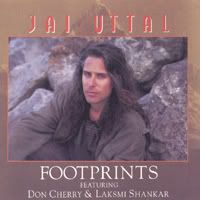
His break came in 1991 when Triloka released his debut, Footprints, which included an appearance by jazz and world music innovator Don Cherry. With his band, the Pagan Love Orchestra, Uttal continued to mine spiritual, Indian-inflected music two years later on Monkey, which hit the Top Ten on the world music charts. Uttal also found himself producing his mentor, Ali Akbar Khan, for two records, Journey and Garden of Dreams, which found the maestro working with a Western orchestra for the first time. Uttal's next release, 1994's Beggars and Saints was his tribute to the Bauls of Bengal, in thanks for his formative time in Bhopur.

Three years later came Shiva Station, which was mixed by innovative producer Bill Laswell. After that he concentrated on touring with his band rather than recording. A compilation of his four Triloka albums appeared as Spirit Room in July 2000, shortly before the self-released Live Kirtan and Pagan Remixes, which, along with remixes of three Pagan Love Orchestra tracks, was comprised of chanting by Uttal recorded live in a yoga studio. It was followed by another remix EP, Guru Brahma/Malkouns, which included two cuts mixed by Asian Underground star Talvin Singh.

Courtesy : Chris Nickson

Listen to Jai Uttal singing Guru Brahma in his ever enchanting voice :


I also urge you to listen to this captivating song Bajrangi which he has rendered in Raga Durga (please correct me if I am wrong) :


Find more music of Jai Uttal in my new music folder at eSnips : Indian.Raga.New.Age.

Monday, November 12, 2007

Kabir Altaf : a new star on the horizon


I came to know Kabir Altaf accidently. I was searching for the present state of hindustani classical music in Pakistan on the internet and I found a few sound clips. When I first heard Kabir sing a Meera bhajan Badal Dekh Daree, I imagined him to be an old and seasoned singer of the past era. But how wrong I was.

A few days after I uploaded these sound clips on my Hindustani.Classical.Music folder at eSnips, I received a message from Kabir himself telling me how happy he was to find those clips on the internet. He is a mere 21 years of age and a student in the U.S. and he is still learning classical music. I was quite taken aback at knowing about his young age and such maturity in his voice. Only one other singer I know, has such a voice quality at an young age, who also had surprised me earlier. That is Moumita Mitra about whom I have written earlier.

Kabir Altaf was born in Karachi, Pakistan on February 3, 1986. At the age of 6, he moved with his family to the United States, where he grew up. Kabir has been learning Hindustani Classical Vocal from Ustad Hamid Hossain (based in Baltimore, Maryland) ever since he was ten years old. He has won several prizes at the Annual Indian Music and Dance Competition hosted by the Academy of Indian Music and Fine Arts and the University of Maryland-Baltimore County.

Kabir is currently a student at The George Washington University in Washington DC, where he is majoring in Music (Western Classical Vocal) and Dramatic Literature. He hopes to have a career that revolves around the performing arts, either as a professional musician or in arts-management.

Listen to this Meera Bhajan by him which he has sung with the maturity of a seasoned artist :


Wednesday, November 07, 2007

gupta.agra's Classical.Music collection at eSnips


I am fortunate enough to have collected a large number of hindustani classical music songs over a period of couple of years. I have uploaded some in my eSnips folder :

Hindustani.Classical.Music

I am no expert of classical music nor do I understand the intricacies and technicalities of such music but still I am fascinated by it. My eSnips folder is a tribute to all those young artists who have chosen to sing this genre of music inspite of better financial and glamourous lure of playback singing in the film world. Only an absolute dedication and love for their art has prevented them from swaying to the 'other' side.

I have included about 150 artists, some of them are very young and relatively less known but in no way less talented. I am also very happy to tell you all, that this eSnips folder has attained Google Page Ranking of 3 within two months. This blog too has a 2 ranking and my other blog Indian Raga at Wordpress has a Google Ranking of 4. Both these were created about the same time as my eSnips folder. This just proves that hindustani classical music is becoming more popular than ever before.

Hindustani Classical Music artists included in my eSnips folders are :

  • Adnan Sami (Piano)
  • Ajay Pohankar
  • Ajoy Chakrabarty
  • Ali Akbar Khan
  • Amelia Cuni
  • Amjad Ali Khan
  • Anita Sen
  • Anoushka Shankar
  • Anup Jalota
  • Anuradha Kuber
  • Arati Ankalikar
  • Ashiq Ali Khan
  • Ashwini Bhide
  • Bade Ghulam Ali Khan
  • Badar-uz-Zaman
  • Barkat Ali Khan
  • Begum Akhtar
  • Bhimsen Joshi
  • Bismillah Khan
  • C R Vyas
  • Chandrakantha
  • Channulal Mishra
  • Chitra Singh
  • D V Paluskar
  • Devki Pandit
  • Dilraj Kaur
  • Dilshad Khan
  • Dinkar Kaikini
  • Farida Khanum
  • Fateh Ali Khan (Patiala Gharana)
  • Firoz Dastur
  • Ganpati Bhat
  • Gauhar Jan
  • Ghulam Ali
  • Ghulam Hassan Shagan
  • Ghulam Mustafa Khan
  • Girija Devi
  • Hariprasad Chaurasia
  • Iqbal Bano
  • ITC-SRA Scholars
  • Jagdish Prasad
  • Jagjit Singh
  • Jai Uttal
  • Jayanti Sahasrabuddhe
  • Jitendra Abhisheki
  • Kabir Altaf
  • Kalapini Komkali
  • Kalpana Zokarkar
  • Kaushiki Chakrabarty
  • Khansahib Nasiruddin Saami
  • Kishori Amonkar
  • Kumar Gandharva
  • L Shankar (Violin)
  • Lakshmi Shankar
  • Latafat Hussain Khan
  • M S Subbulakshmi
  • Malini Rajurkar
  • Malavika Kanan
  • Mallikarjun Mansur
  • Mehdi Hassan
  • Mitali Banerjee Bhawmik
  • Mohammad Bakhsh
  • Moinuddin & Aminuddin Dagar
  • Moumita Mitra
  • Mubarak Ali Khan
  • Munawar Ali Khan
  • Nazakat & Salamat Ali Khan
  • Nirmalya Dey
  • Pandit Jasraj
  • Parween Sultana
  • Prabha Atre
  • Rajan & Sajan Mishra
  • Rashid Khan
  • Ratna Basu
  • Ravi Shankar
  • Rita Ganguly
  • Saleem Khan
  • Sanjeev Abhyankar
  • Satyasheel Deshpande
  • Sawani Shende
  • Shivkumar Sharma
  • Shobha Gurtu
  • Shruti Sadolikar
  • Shubha Mudgal
  • Shujaat Khan
  • Sipra Bose
  • Subha Joshi
  • Subhra Guha
  • Sultan Khan (Sarangi)
  • Taufiq Qureshi
  • Trilok Gurtu
  • Uday Bhawalkar
  • Ulhas Kashalkar
  • Vaishali K S
  • Vasundhara Komkali
  • Veena Sahasrabuddhe
  • Vishwa Mohan Bhatt
  • Zahida Parveen
  • Zakir Hussain
  • Zarina Begum
  • Zila Khan

... and many more.

More artists will be added soon. While visiting my classical music folder at eSnips don't forget to have a peek into my other music folders which have some interesting music of different genres. All the music is raga based.

Link to my Esnips profile and all my folders :

http://www.esnips.com/user/guptaagra

Enjoy!

Thursday, October 25, 2007

British Raj and Indian Classical Music


When you think of Carnatic music, you think of temples, music which has retained its pristine purity over the ages and something strongly South Indian. But Carnatic music like all Indian art forms has been open to various cultural influences from all over the country and across the seas. Strange as it may sound, the British Raj and its bands have left a firm imprint on this most traditional music form. Muthuswami Dikshitar and Thyagaraja, two of the most revered composers of Carnatic music, were certainly influenced by the strange tunes from the British.

Perhaps the earliest innovation was the violin. This very Western instrument became part of the Carnatic music tradition when the family of composer Ramaswami Dikshitar moved from Tiruvarur to Madras in the 1790s. The five-year stay exposed brothers Muthuswami and Baluswami Dikshitars to the ‘airs’ that were being played by the Fort St George orchestra.

Baluswami Dikshitar learnt to play the violin from an Englishman and introduced it to the Carnatic concert platform. Muthuswami Dikshitar composed around fifty verses in Sanskrit, based on the orchestra’s music. The most famous among these is ‘Santatam Pahi Mam Sangita Shyamale’ which is set to the same tune as ‘God Save The King’! Muthuswami Dikshitar’s contemporary, Thyagaraja, composed ‘Raminsuvar Evarura’ in the Raga Suposhini, which was clearly inspired by music that accompanies march pasts.

His ‘Vara Lila Gana Lola’ in Raga Sankarabharanam, is also completely based on Western band tunes. Thyagaraja used words that had come into Telugu from English in some of his compositions. The usage of the word Landaru (from Lantern) in the kritiEmi Jesite Nemi’ (Raga Todi) and Shalu (from Shawl) in the kriti ‘Jutamurare’ (Raga Arabhi) are examples.

The British were not immune to the beauty of Carnatic music. We have instances of singers such as Maha Vaidyanatha Sivan being appreciated by British officials. The antics and contortions of Sivagangai Periya Vaithi, are said to have scared at least one British Mem into hysterics.

Gopalakrishna Bharat’s Nandan Charitram moved a French official of Karaikkal to such an extent that he funded the first publication of the work. The Madras Jubilee Gayan Samaj opened its office in 1883 and among its patrons were such senior officials as Sir Charles Turner, Col McLeod and Gen S Chamier.

Programmes featuring Carnatic music were held at the Pachiappa’s Hall in George Town, Madras and many Englishmen attended these events. Patnam Subramanya Iyer, the composer who lived in Madras for 12 years, thereby acquiring the prefix Patnam (city), created the Raga Kathanakutoohalam, which can easily pass off as a melody in Western Music. His song ‘Raghuvamsa Sudha’ in this Raga is a favourite among instrumentalists, specially when they are performing to an International audience.

At the turn of the century, the Harikatha movement (story telling with music) was at its peak. Innovations were happening in this genre. Exponents such as Harikesanallur L Muthiah Bhagavatar and Tirupazhanam Panchapakesa Sastriar were in the fore front. A popular item in their repertoire was the description of Rama’s marriage to Sita. During their discourse they let their imagination run riot and even described a ‘band’ that belted out music during the wedding procession. The ever popular ‘English Note’ was created for this.

The Imperial Durbar of 1911 marked the zenith of the British Raj. The visit certainly influenced classical music. Gauhar Jan of Calcutta and Janki Bai of Allahabad performed a mujra for King George V, and for their song ‘Yeh Hai Tajposhi Ka Jalsa Mubarak Ho Mubarak Ho’ they were given a gift of 100 guineas. M Lakshmana Suri of Madras, father of Judge and musicologist T L Venkatarama Iyer and uncle to Harikesanallur L Muthaiah Bhagavatar, composed a set of 100 verses in Sanskrit on the King. It was titled ‘George Deva Shatakam’. He was awarded the title of Mahamahopadhyaya for the effort.

The Muthialpet Sabha of George Town, Madras, announced a competition among composers for coming up with a song on King George. The eminent vocalist and composer Ramanathapuram 'Poochi' Srinivasa Iyengar was awarded the gold medal for his kritiSatatamu Brovumayya Chakravartini’ in Raga Todi. A mangalam (benediction) too was composed. It goes ‘Jayatu Jayatu Sarvabhauma George Nama, Sundari Mary Ragni Sahita Vijayi Bhava’.

It must have been very pleasant for Queen Mary to be called a beauty. Sadly the composer is not known. In the mid-thirties, Chittoor V Nagaiah released a 78 rpm recording of a Javali, that began with the words ‘O my lovely Lalana’. The song is a delightful mix of Telugu and English. Much closer to Independence, Ariyakkudi Ramanuja Iyengar had the occasion to perform before an English collector. In order to impress him, Iyengar began with the English note. The man was not happy. ‘‘When will you sing ‘Entaro Mahanubhavulu’?’’ he asked. Carnatic music had come full circle.

The influence has not vanished with the end of the British Raj. During the Rishabha Vahanam procession at the Kapaleeswarar temple in Mylapore, it is customary for the bearers of the idol to dance to the tune of a band during the last lap of the event. The tunes played are the English note and... hold your breath, ‘For He’s a Jolly Good Fellow’! But then that is quite a good description of the Lord.

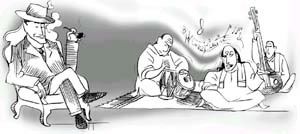
Listen to this song by Zohra Bai Agrewali that reminds us of that lost era of Kings and Maharajas and their courtesans :


Courtesy : Sriram V